The tulip is a bulbous spring flower from the lily family, native to the mountain steppes of Central Asia. Modern culture counts about 110 wild species and over 3,000 cultivars split into 15 garden classes. This guide covers which tulip to pick for a bouquet, how to keep it fresh up to 14 days, and why 17th-century Dutch merchants paid the price of an Amsterdam townhouse for a single bulb.
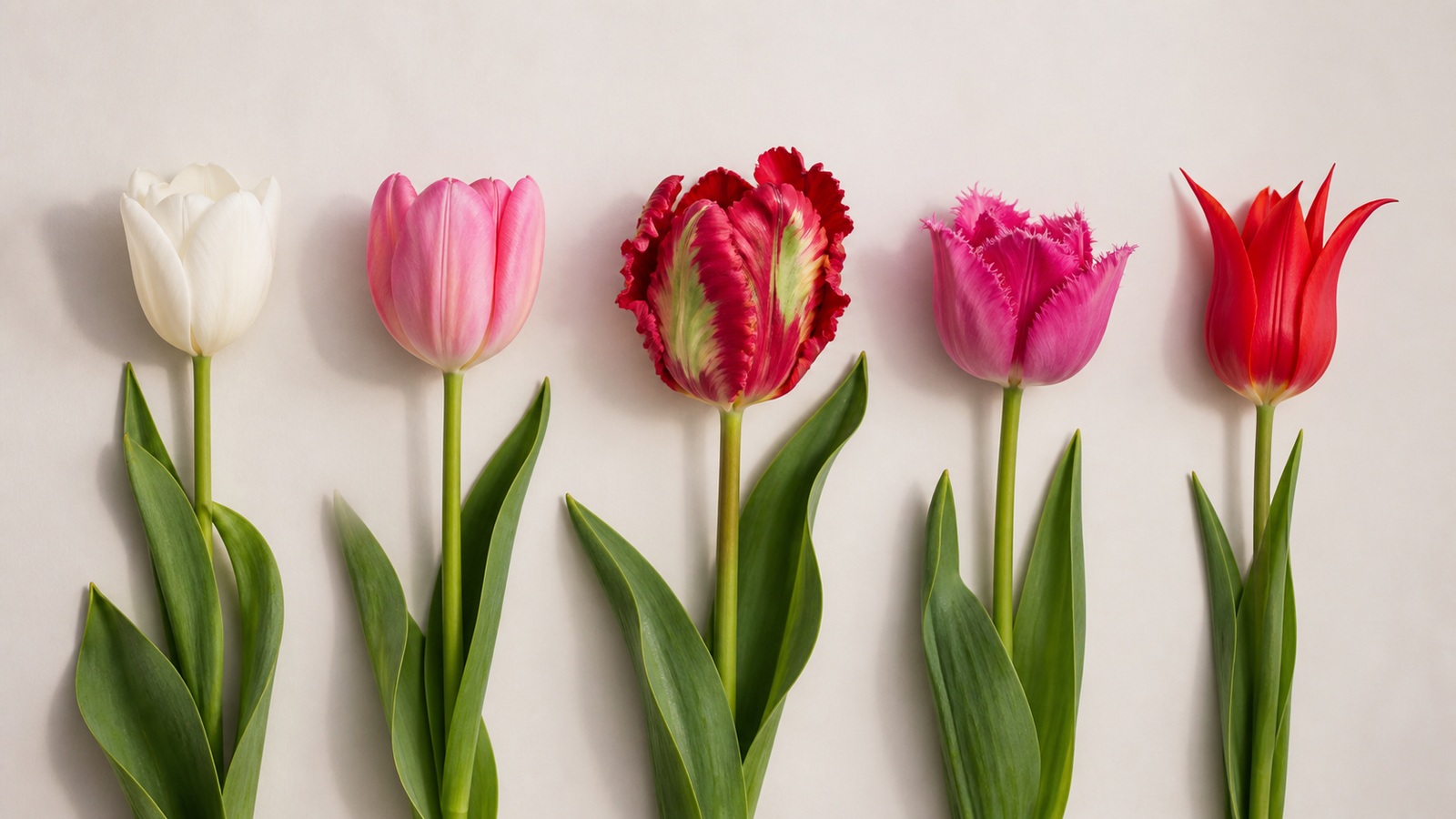
Table of contents
- Botany and origin
- Classes and popular varieties
- Care in the open ground
- Cut tulips — how to keep them fresh
- Use in bouquets
- Symbolism and the language of flowers
- Facts and history
- Common mistakes and how to avoid them
Botany and origin
The tulip (Tulipa) is a genus of herbaceous perennials in the lily family. Biologists include 87–110 wild species; the exact number is still under revision — some forms are considered subspecies, some separate taxa. Height ranges from 8 cm in mountain T. humilis to 75 cm in Darwin hybrids.
The tulip's homeland is the mountains of the Tien-Shan, Pamir, and eastern Turkey. Wild populations still occur in Kazakhstan, Kyrgyzstan, the Pamirs, and eastern Anatolia. The flower is adapted to a sharply continental climate: short hot summer, cold winter, spring meltwater — all of which drive the bulbous life cycle.
The flower has six petals (technically tepals) and six stamens. Leaves are typically waxy blue-green, 12–35 cm long. The root system is fibrous, regenerated each season — old roots die together with the previous year's bulb.
Garden tulip (Tulipa × gesneriana) The hybrid complex covering most modern cultivars. Height 25–75 cm, flower diameter 5–12 cm, blooming April–May in temperate climates. Winter-hardy to −35 °C with a 5–7 cm mulch layer.
Bulb life cycle
The key thing that separates tulips from most ornamentals — bulb renewal every year. The mother bulb feeds the flower stalk and dies down, while one large replacement bulb and 2–4 smaller offsets form in its place. That's why growers dig planting stock annually — after foliage yellows, in June–July.
Important note: the bulb requires cold stratification — 12–16 weeks at +2…+9 °C. Without that dormant period the flower bud doesn't form, and the plant produces only leaves in spring.
Classes and popular varieties
The international registry (KAVB, Netherlands) splits tulips into 15 classes by bloom timing, shape, and origin. For buyers and hobbyists, 6–7 groups matter — they cover 90% of commercial supply.
Triumph
The mass class — around 25% of world production. Bred by crossing early singles with Darwin tulips. Height 40–60 cm, dense goblet bud, straight strong stem. Bloom: late April and first ten days of May. Triumphs are the ones industrial growers force for March 8 — they endure cut floristry conditions best.
Signature varieties: White Dream (pure white, 50 cm), Negrita (dark purple, 45 cm), Strong Gold (saturated yellow, 55 cm), Barcelona (fuchsia, 50 cm).
Darwin hybrid
Bred in the 1940s by Dutchman Dirk Lefeber by crossing Darwins with wild T. fosteriana. Height 60–75 cm, cup up to 12 cm at full opening. Blooms 5–7 days later than Triumphs, from early to mid-May.
Height and flower-size record holders — used for statement mono-bouquets of 25–51 stems. Classics: Apeldoorn (scarlet), Pink Impression (pink, 11 cm cup), Golden Parade (yellow), Ollioules (pink-white bicolor).
Parrot
The most theatrical class. Petals slashed, twisted, often with a crimp at the edge and contrasting green or crimson striations. Height 40–55 cm, late bloom — mid to late May. Tricky as cuts: heavy bud, stem bends under weight.
Hits: Black Parrot (dark purple, near-black), Estella Rijnveld (white-red, up to 14 cm), Rococo (wine red with green tongue), Apricot Parrot (apricot-pink).
Fringed (Crispa)
Needle-like fringes along the petal edge — like frost. Height 45–65 cm; bloom coincides with Triumphs and Darwins. The fringe is a stable genetic trait — stays crisp even on day 10 in the vase.
Notables: Honeymoon (white), Cuban Night (ink-purple), Curly Sue (fuchsia), Lambada (orange with yellow edge).
Lily-flowered
Elongated bud with pointed reflexed petals — a lily silhouette. Height 50–65 cm, late bloom. Great for elegant asymmetric ikebana and French-school arrangements.
Top sellers: Pretty Woman (scarlet), Ballade (purple with white edge), White Triumphator (snow white), Sapporo (cream, fades to white).
Double early and late
Flowers like peonies — 40–60 petals in a dense ball. Height 25 cm (early) to 55 cm (late). Foxtrot (pink) and Charming Beauty (orange-apricot) are used by florists as peony substitutes in March–April before real peonies bloom.
Class comparison
| Class |
Height, cm |
Bloom |
Vase life |
Price per stem, USD |
| Triumph |
40–60 |
Late April |
7–10 days |
$1.50–2.70 |
| Darwin Hybrid |
60–75 |
Early May |
10–14 days |
$2.70–4.50 |
| Parrot |
40–55 |
Mid-May |
5–8 days |
$3.60–6.30 |
| Fringed |
45–65 |
Late April |
8–12 days |
$3.20–5 |
| Lily-flowered |
50–65 |
Mid-May |
7–10 days |
$3–4.90 |
| Double late |
35–55 |
Mid-May |
6–9 days |
$4–7.20 |
Care in the open ground
Tulips are sun-lovers. Minimum 6 hours of direct light a day, drained soil at pH 6.5–7.5, no standing water. On heavy clay, the bulb rots in two seasons — a 5 cm sand cushion at the bottom of the planting hole saves it.
Timing and depth
Best planting window in temperate zones — Sept 15 to Oct 10, when soil at 10 cm cools to +9…+12 °C. Earlier, the bulb grows and freezes back; later, it doesn't root before the ground freezes.
Depth rule: bulb height × 3. For an extra-large bulb (12+ cm) that's 12–15 cm from base to surface. Spacing — 8–10 cm for garden plantings, 4–6 cm for forcing.
Feeding by phase
- At planting (September): 30 g superphosphate + 20 g potassium sulfate per 1 m² at the bottom of the hole
- On emergence (April): N-K mix, 25 g nitroammophos per 1 m² on moist soil
- At bud stage: potassium magnesium 20 g/m² — for intense petal color
- After bloom (May–June): monopotassium phosphate 15 g per 10 L water — for next-year bud set
Fresh manure is absolutely excluded — it triggers Fusarium and root burn. If you want organic, only well-rotted compost worked into the soil six months before planting.
Agronomist's tip. After bloom, don't cut leaves right away — they must yellow and dry completely. It's through the green foliage that the replacement bulb feeds up for the next season. Cut leaves too early and next April you'll get a "blind" shoot with no flower.
Diseases and protection
The tulip's main enemies are Tulip Breaking Virus (TBV), gray mold (Botrytis tulipae), and Fusarium. The virus doesn't heal: infected plants with mottled petals and streaked leaves are dug up and burned to keep aphids from spreading it.
Gray mold prevention: 4-year rotation, and 30-minute soak of bulbs in benomyl (2 g/L) or "Maxim" fungicide before planting. Mortality drops from 18% to 3–4% after such treatment.
Cut tulips — how to keep them fresh
This flower keeps growing in the vase — the stem lengthens 2–5 cm a week, the bud turns toward light. These traits dictate handling.
Buy tulips at the "colored bud" stage: the goblet still closed but color is 70–80% showing. A fully open flower lasts 2–3 days; a very tight one with green streaks may not open at all.
Stem preparation
- Trim at 45° with a sharp knife, not shears (shears crush the vessels)
- Refresh the cut every 2 days, taking 1–1.5 cm
- Remove the whole white bulb-end of the stem — it rots fastest
- Strip all leaves below the waterline — bacteria bloom within 24 hours otherwise
- Wrap 5–7 stems tightly in newspaper for 2 hours in cold water — stems straighten and rehydrate
Water, temperature, additives
Ideal water: cold, +4…+8 °C, allowed to stand 6+ hours. Warm water halves bouquet life: at +20 °C tulips last 4–5 days; at +6 °C — up to 12. Change water daily; wash the vase without soap residues.
Additives (pick one):
- Sugar + citric acid: 1 tsp sugar and a pinch of citric acid per 1 L water
- Aspirin: half a tablet per 1 L — acidifies water, slows bacteria (weakly)
- Silver coin: grandmother's method that actually works with pure silver as a mild biocide
- Commercial preservative (Chrysal, Floralife): ready solution per instructions, extends life 3–5 days
Florist's hack. To keep tulips upright and prevent them "falling" in the vase, pierce the stem right below the bud with a thin needle — all the way through. This halts hydrostatic pressure and keeps the flower vertical for 5–7 days. Verified at the Dutch FloraHolland auctions.
Use in bouquets
The tulip is a universal florist's flower — works in strict masculine mono-bouquets and in airy bridal compositions. Its laconic form demands thought — not every pairing works.

Mono-bouquets
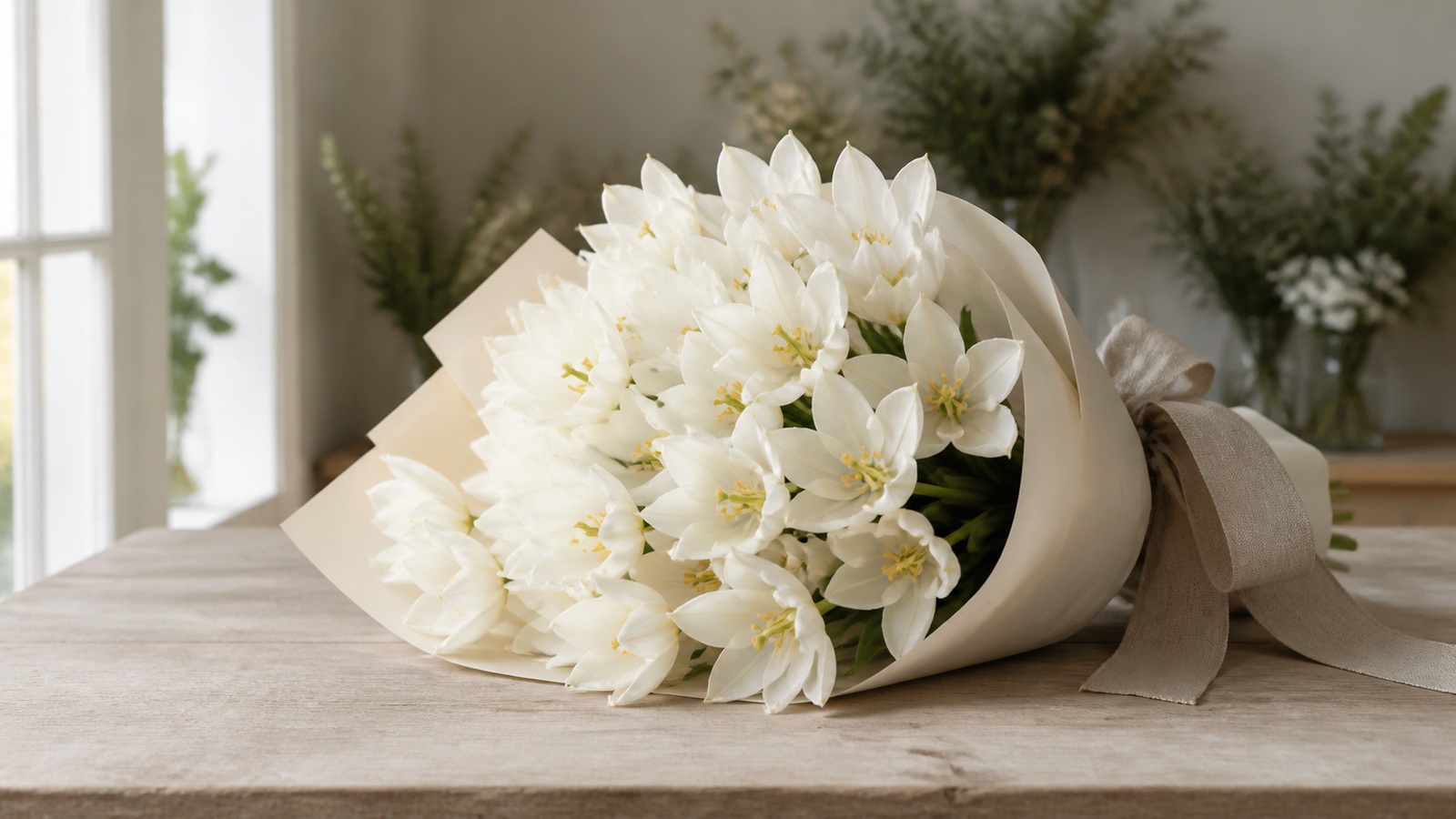
An even count in some Eastern European traditions is funeral, so gift bouquets use 25, 35, 51, 75, or 101 tulips. The bestseller for March 8: 25 stems of one variety in kraft, no greenery, tied with a 4 cm linen ribbon.
For a "spring vs winter" outdoor bouquet, use Darwins on 65–75 cm stems — they hold form even at −5 °C for a short walk from car to entrance, while Triumphs wilt within 15 minutes outdoors.
Mixed compositions
Working partners:
- Hyacinth — echoes the bulbous "spring" aesthetic, adds scent
- Ranunculus — similar bud density, plays on texture contrast
- Silver eucalyptus — the blue-grey foliage sharpens the petal
- Apple and magnolia branches — add height and seasonal context
- Anemone — the anemone's dark center rhymes with the tulip's dark base
What doesn't work: tulips + narcissi. Narcissi release a slime that clogs tulip vessels within 4–6 hours. If you want them together, condition narcissi separately for 12 hours first, then move to the shared vase without re-cutting.
Wedding floristry
In classic bridal bouquets, tulips ranked first in mentions in April–May 2024 wedding magazines — 38% of covers. Lily-flowered and double forms give the desired "delicacy without banality," and pastel varieties (Angelique, La Belle Epoque, Apricot Beauty) fit any palette from dusty pink to caramel.
"The tulip is the most honest flower in a bridal bouquet. It doesn't hide behind greenery, doesn't disappear into filler, holds the line of the stem like a ballerina. When I build a cascade bouquet, I start from the tulip — it sets the rhythm of the whole composition."
Symbolism and the language of flowers
Meaning depends on culture and era. In the 16th-century Ottoman Empire the tulip was a symbol of the divine — the Arabic script of "lale" (tulip) coincides with "Allah." In Topkapı Palace there was a dedicated "tulip eunuch" position, responsible for the sultan's collection.
In 17th-century Netherlands the tulip became a symbol of wealth, status, and speculation at once — during the famous "Tulipmania" of 1634–1637. In the Victorian era, red tulip meant a declaration of love; yellow — unrequited passion; variegated — a compliment on the recipient's eyes.
Modern color code
- Red: passionate love, declaration (universal)
- White: purity of intent, forgiveness — christenings, post-argument peace
- Yellow: sun and joy (the Slavic "parting" myth was debunked by florists in the 2000s); friendship in the West
- Pink: gentle affection — mom, sister, mentor
- Purple / black: aristocracy, admiration — statement business gifts
- Bicolor: compliment on appearance ("you have beautiful eyes")
The tulip is the national flower of four countries: Turkey, Netherlands, Hungary, and Kyrgyzstan. In Istanbul, every April holds Lale Festivali — up to 30 million bulbs planted along streets in a season.
Facts and history
Tulipmania
At the peak of speculation in February 1637, one 'Semper Augustus' bulb sold for 10,000 florins — the price of a large Amsterdam townhouse. The market collapsed in a single day: on Feb 3, 1637, an Alkmaar auction failed to attract buyers. Wholesale prices fell 90% within a week, ruining thousands of merchants.
The USSR's tulip empire
Between 1932 and 1937, the Nikitsky Botanical Garden in Crimea bred over 200 cultivars under Sabina Ordovskaya. Some — 'Beryozka', 'Krasnaya Chapayevka', 'Almaz' — are still grown today. The USSR was the world's third-largest tulip exporter until 1953.
Rare and expensive
The world's rarest cultivar today is 'Queen of Night' 2.0 — an experimental near-black form bred in 2021 in the Netherlands. Sold only through closed auctions at €180 per bulb. Standard 'Queen of Night' is available at $1.20 per bulb.
Common mistakes and how to avoid them
- Deep planting. Deeper than 3× bulb height = no flower next year. The bulb spends energy pushing through soil.
- Cutting leaves right after bloom. Kills the replacement bulb. Wait for full yellowing.
- Warm vase water. Halves vase life. Use cold — +4…+8 °C.
- Narcissi in the same vase. Toxic sap for tulips. Condition separately for 12 hours.
- Watering during bloom. Tulip petals rot from droplets on the flower. Water at the root only.
- Buying fully open flowers. They'll last 2–3 days maximum. Choose colored but tight buds.
Want fresh spring tulips or a spring composition? Browse tulips with delivery — mono-bouquets from $15, designer compositions from $50, in-season March through May.
Master three rules — colored-bud stage at purchase, cold water, no narcissi in the same vase — and even a supermarket tulip bouquet will last 10 days. And if you plant your own bulbs in September, in the third week of April you'll get free flowers to cut for anyone you want.
— Sofia Bell