Gerbera is an African daisy with a flower head 4 to 15 cm across and a palette of 30+ shades. Breeders have registered 100+ varieties, and the cut flower holds 10–14 days with proper care. This guide covers the botany, growing, floristry, and symbolism.
Botanical description
Gerbera is a genus of herbaceous perennials in the Asteraceae family. Described in 1737 by the Dutchman Jan Gronovius and named after the German botanist and physician Traugott Gerber. Native range covers South Africa, Madagascar, Southeast Asia, and South America.
The genus counts about 30 wild species, but commercial floristry rests on the hybrid Gerbera × hybrida — a cross of G. jamesonii and G. viridifolia performed in Cambridge in the 1890s by Robert Lindsay.
Structure
Fibrous roots reaching 25–30 cm. A tight basal rosette of pinnate leaves 15–35 cm long, softly hairy. The scape is leafless, 30–60 cm tall in cut varieties, 15–25 cm in pot ones.
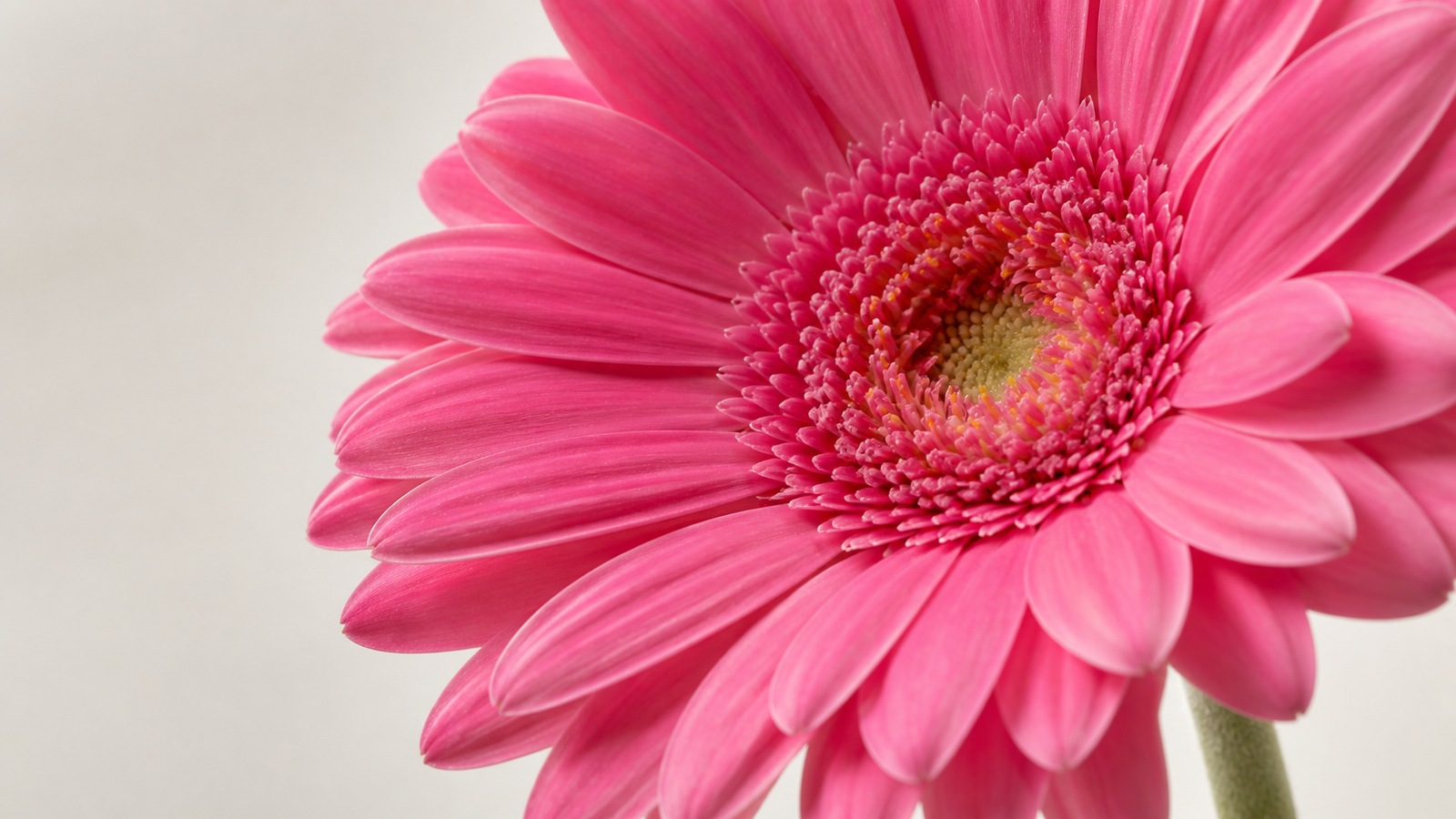
What looks like a single flower is actually a composite head. The outer edge holds ray florets (what people call "petals"); the center holds tubular or semi-tubular ones. In double varieties, the tubulars also transform into rays and the head looks packed.
Size and palette
Head diameter ranges from 4 cm in mini "Germini" series to 15 cm in large-flower cultivars like 'Pasadena' and 'Tomahawk'. Natural coloring runs from pure white to burgundy with pastel intermediates. No blue gerberas exist in nature — the blue on the market is hand-dyed via the stem.
Varieties and classification
Professional plantations in the Netherlands, Colombia, and Kenya offer roughly 400 commercial varieties. Classification by shape, size, and purpose:
By head shape:
- Single — one or two rows of ray florets, open center. Cut classic, ~45% market share
- Semi-double — two or three rows, center still visible
- Double — dense rows filling the center; peony-like
- Spider — long narrow petals like a spider's legs
By size:
- Standard (10–15 cm head) — for statement bouquets
- Mini/Germini (4–7 cm head) — for compact compositions and boutonnieres
Top-selling varieties:
- Pasadena — large pink standard, market flagship
- Tomahawk — bright orange, autumn palette
- Serena — cream-yellow, elegant
- Black Jack — burgundy near-black, dramatic
- Bella — bright pink mini for boutonnieres
Gerbera in the garden and on a windowsill
Gerbera is a warm-climate perennial (USDA zones 8–10). In temperate zones it's grown as an annual or pot plant.
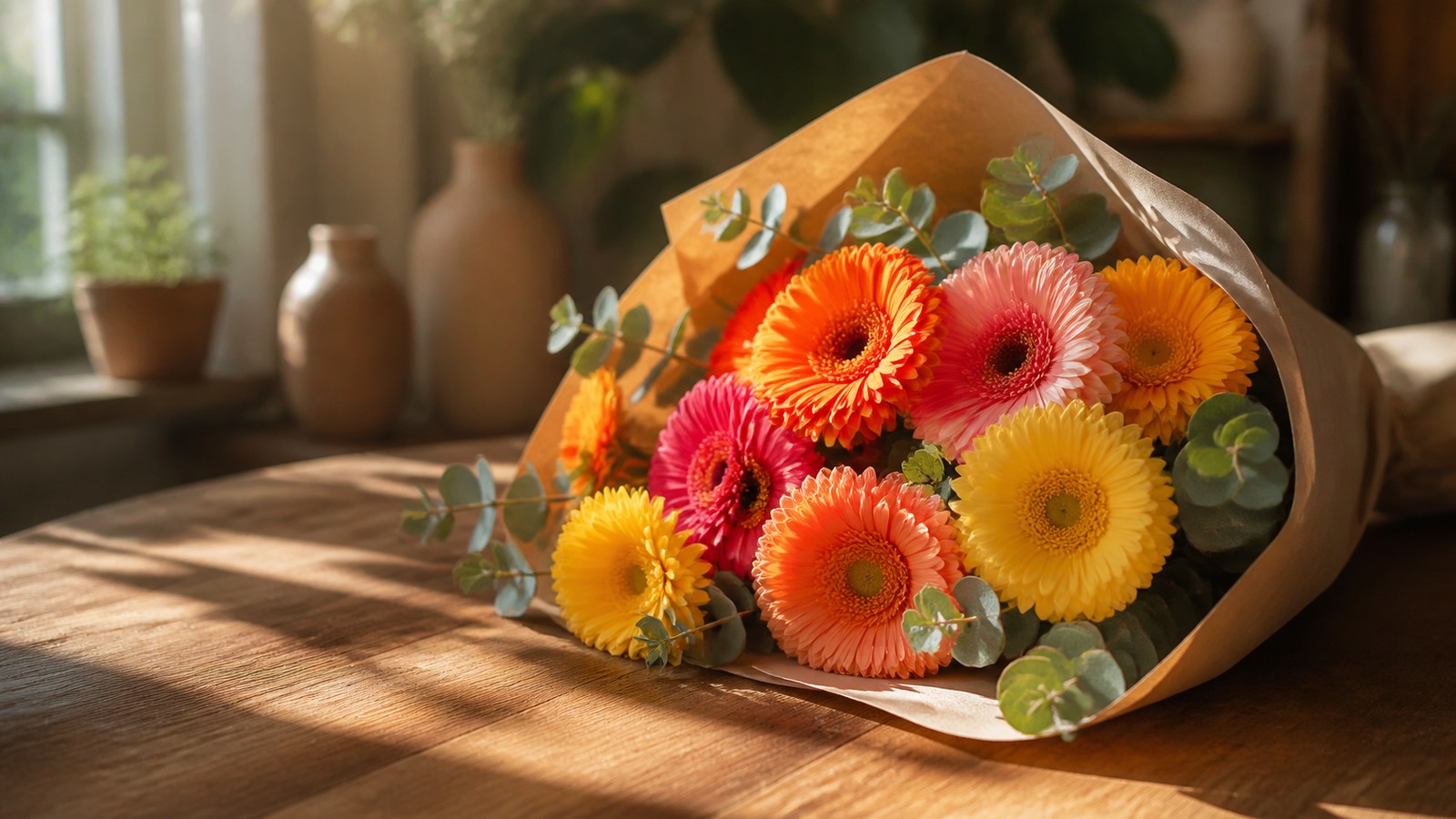
Position: bright light, but not direct hot sun. Ideal — an east or west window.
Soil: light, well-drained, slightly acidic (pH 5.5–6.5). Add perlite and sand.
Watering: moderate. Overwatering kills the crown — water at the pot edge, not the rosette center.
Feeding: every 2 weeks during growth with a balanced liquid fertilizer.
Rest: in winter, gerbera enters dormancy — reduce watering, keep at +12…+15 °C. Skipping the rest costs the following year's bloom.
Cut care in a vase
Gerbera is capricious as a cut. The main problem — head droop from a weak stem.
- Cut stems at 45° with a knife (not shears) under running cool water
- Use a deep narrow vase — the stem should be supported to two-thirds its length
- Cool water (12–15 °C), no more than 5 cm depth
- Change water daily — the stems rot easily in stagnant water
- Add flower food — the gerbera responds strongly to Chrysal
Head-droop trick: thread a florist's wire through the stem right below the head — supports it internally for 10+ days.
Vase life: 10–14 days with proper prep. In a warm room — 5–7 days.
Gerbera in floristry and bouquets
Gerbera is often called a "school flower" — perceived in some cultures as budget or juvenile. In reality it's a florist's utility flower with a huge palette and long vase life.
Working combinations:
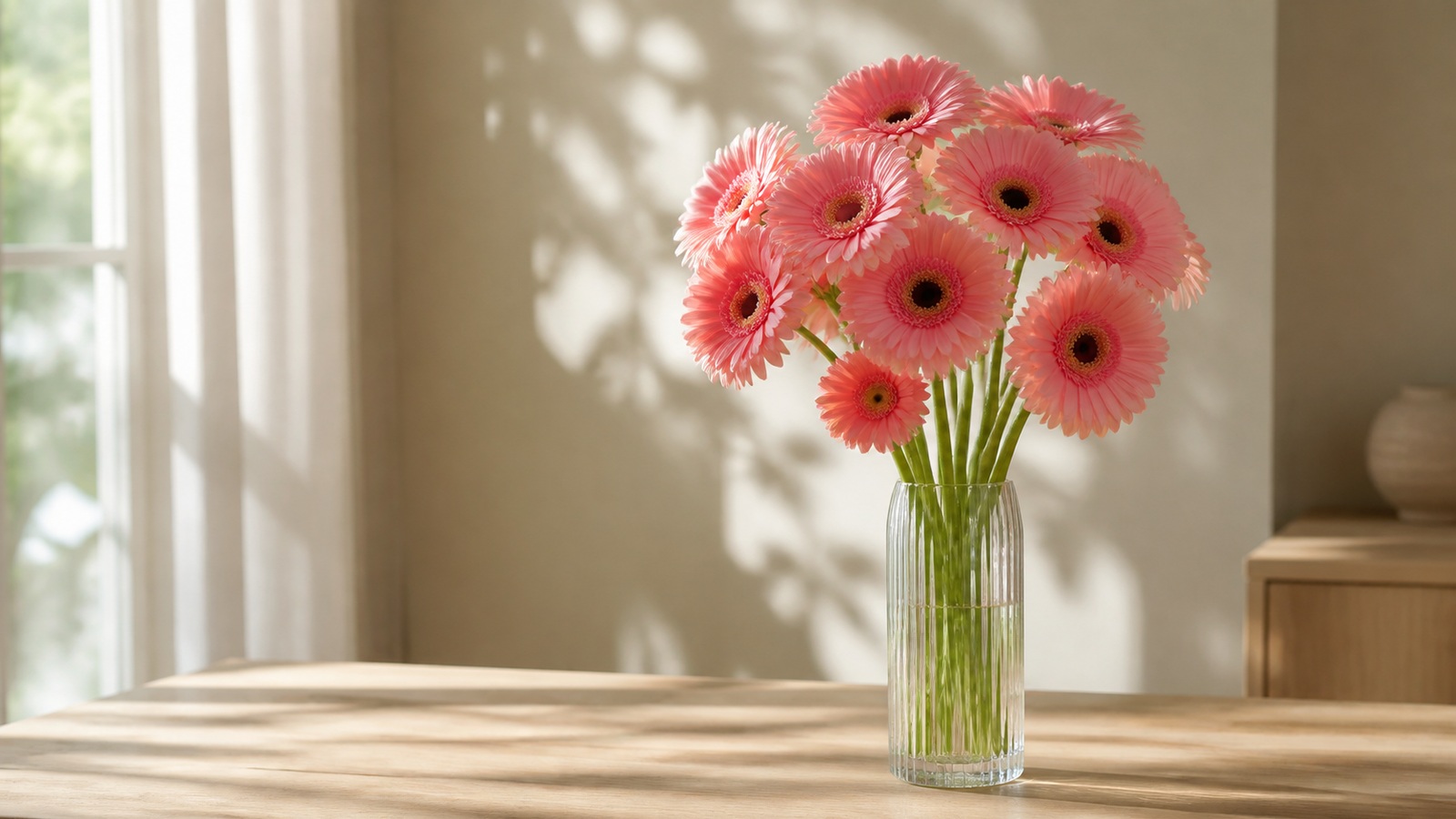
- Gerbera + eucalyptus (universal daily bouquet)
- Gerbera + chrysanthemum (school and teacher bouquets)
- Orange gerbera + wheat + sunflower (autumn palette)
- Pink gerbera mini + spray rose + lisianthus (bridal bouquet)
Combinations that don't work:
- Gerbera + peony (visual competition)
- Gerbera + Dutch tulips (color palette clash)
- Gerbera + gladiolus (silhouette mismatch)
Gerbera works best in mono-bouquets of 7–15 stems in similar tones. For gifting to a colleague, teacher, or friend, this is one of the most winning formats.
Symbolism and the language of flowers
Gerbera is a symbol of innocence, joy, and simplicity. It doesn't carry a "heavy" cultural load like the rose or peony — its meaning is straightforward: warmth without romantic subtext.
- Yellow — joy, sunshine, gratitude (a teacher's classic)
- Orange — energy, optimism, warm feeling
- Pink — tender affection, non-romantic sympathy
- Red — passion, love (a rare use of gerbera)
- White — purity, sincerity, innocence
- Burgundy — mature respect, deep gratitude
In China, gerbera is a "happiness flower" often gifted at family holidays. In the West, it's a "get-well soon" flower — hospital bouquets and recovery gifts frequently center on gerberas.
Seven facts about gerbera
- Named for a German doctor. Traugott Gerber — 18th-century German botanist and physician
- The world's 5th most in-demand cut flower (after rose, chrysanthemum, tulip, and lily)
- Cheek muscle memory. Studies show that seeing a gerbera makes people smile involuntarily in 67% of cases — the highest among flowers
- No blue in nature. All "blue" gerberas on the market are dyed
- Head follows the sun. In the garden, gerbera turns its head toward light throughout the day
- A house-mood upgrade. NASA lists gerbera among the top 10 air-cleaning houseplants — absorbs benzene and trichloroethylene
- Cheerful cut life. Gerbera holds "head high" longer than most cut flowers if the stem is threaded with a wire
FAQ
Why did my gerbera droop after two days? Weak stem support and warm water. Use a deep narrow vase, cool water 5 cm deep, and thread a wire through the stem below the head.
Can I keep gerbera at home? Yes — a bright east or west window, cool winter rest, careful watering. The plant blooms 8–10 months a year with proper care.
Which color to gift? Yellow for teachers, orange for a birthday, pink for a friend, white for weddings, burgundy for a mature gift.
How many gerberas in a bouquet? In most cultures — 7, 11, 15, or 25 stems. Odd numbers work universally.
Is gerbera good for weddings? Yes, especially in country-style, boho, or "sunset" palette weddings. Mini gerberas (Germini) also work in boutonnieres.
Are gerberas pet-safe? Yes, non-toxic to cats and dogs. One of the safer flowers to keep at home.
Want a bouquet with gerberas? Browse the catalogue — 30+ colors, mono-bouquets from $30, designer compositions from $60.
Summary: gerbera is an underrated florist workhorse. Big palette, 10–14 days in the vase, safe for pets, cheerful without emotional baggage. Learn the stem-wire trick and it becomes the most reliable everyday flower.
— Sofia Bell