Every week we get the same photo in our DMs: peonies with drooping heads on day three, or roses with blackened stem bases. The captions vary, the essence is the same — "What did I do wrong?"
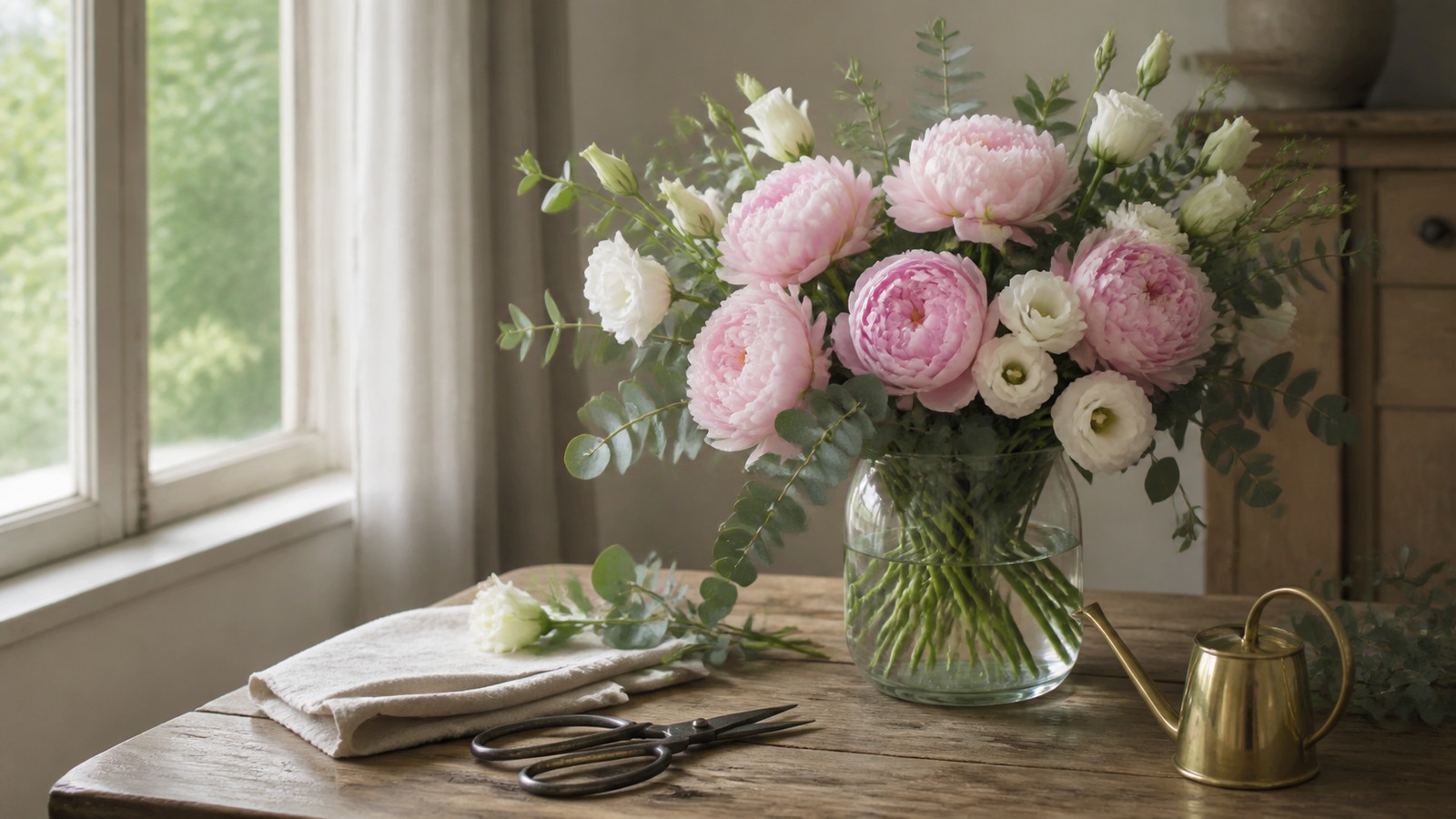
Usually — nothing catastrophic. Just two or three details that cut bouquet life in half. And, more often still, blindly following internet tips: aspirin in the water, sugar, a copper coin.
Here are the seven techniques that actually work. No grandmother's tricks, no myths, and no promises of "a bouquet that lasts a month" (it won't).
1. Re-cut immediately — this is the most important step
A flower drinks water through the stem cut. As the bouquet sits in the shop wrap or rides in a car, the cut dries out and seals over. Put that stem in water and it will "starve" even with three liters of fresh water in the vase.
What to do:
- With a sharp knife (not scissors!), re-cut at a 45° angle, 1–2 cm above the old cut
- Do this under running water or, best, with the stem submerged in a filled sink — so no air enters the cut
- A 45° cut increases water intake area by ~1.5× vs. a flat cut
- Scissors crush and flatten the capillaries. Only a knife — florist, utility, kitchen — anything sharp
Why it works: a fresh angled cut is an "open tube" through which the flower drinks efficiently. An old cut is "a plugged tube."
Re-cut every 2–3 days. Takes a minute.
2. Strip leaves below the waterline
Any leaf in the water starts rotting within 24 hours. Rotting leaves release bacteria; bacteria clog stem capillaries; the bouquet wilts 3× faster.
What to do:
- Before placing in the vase, carefully strip or cut all leaves on the lower third of the stem
- Don't leave "random" leaves "for prettiness" — they rot too
- On thorny stems (roses), strip the thorns as well — they nick other stems
In our practice this is the #2 cause of "bouquet died in two days." #1 is a poor cut.
3. Use a clean vase — every time
Sounds obvious, but 80% of people don't wash the vase before using it — they just fill it from the shelf. Vase walls carry microscopic bacterial colonies from the previous bouquet. Those bacteria multiply instantly in fresh water.
What to do:
- Wash the vase with hot water and a soapy sponge before every bouquet
- Better — a tiny amount of chlorine-based cleaner (1 drop per 200 ml water, then rinse thoroughly)
- If the vase sat empty a long time, there may be residue inside — scrub with salt or citric acid
4. Change water every 2 days
Don't "top up." Don't "refresh." Dump the old and pour new. Critical in summer and in heated apartments in winter — under those conditions the water clouds within a day.
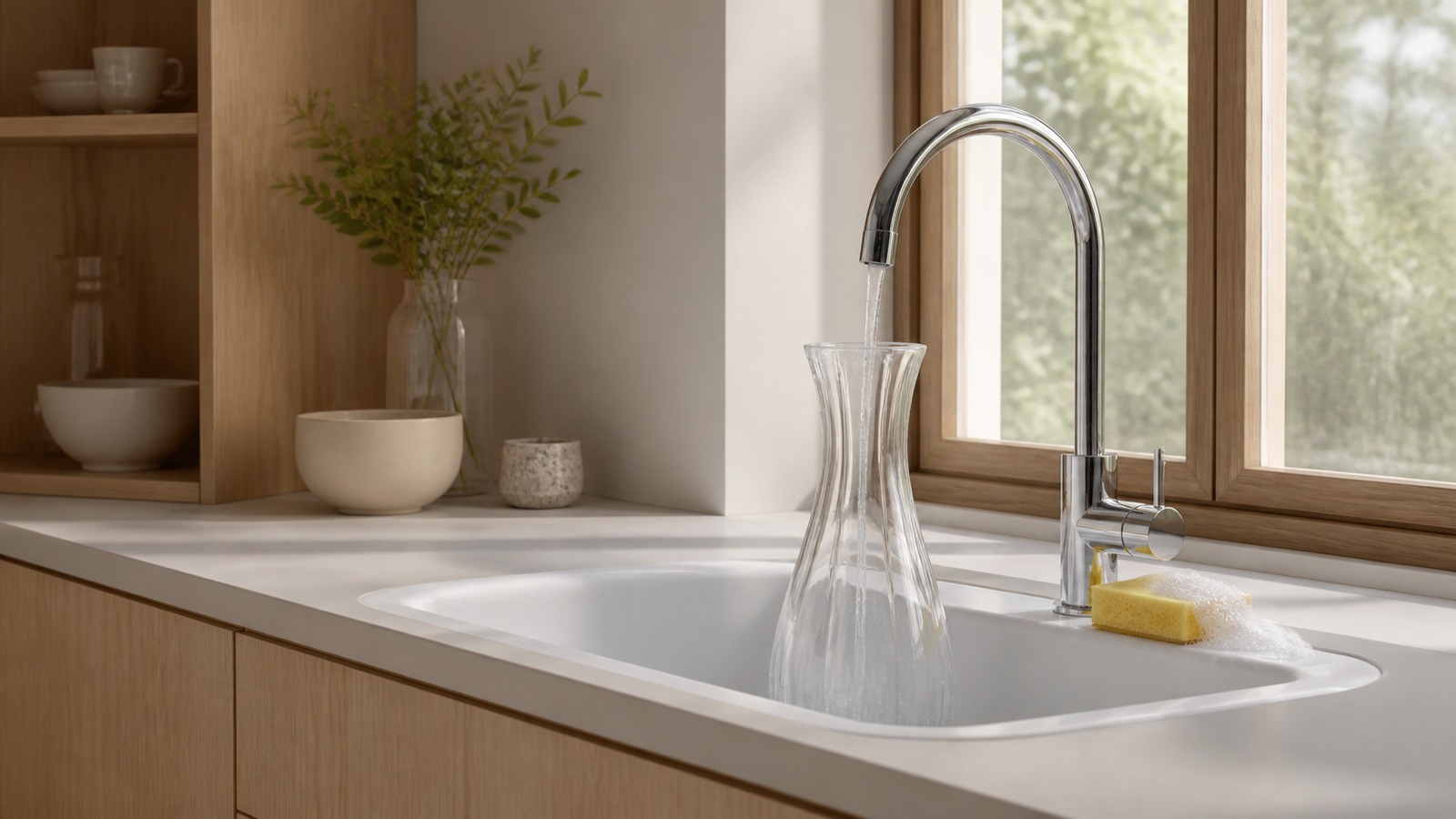
What to do:
- Every 2 days, remove the bouquet, dump the water, rinse the vase under the tap (bacteria stick to the walls)
- Do a fresh re-cut (see #1)
- Pour clean, cool water — in summer, add a couple of ice cubes
- Return the bouquet
The water should fill 2/3 of the vase, no more. "More water is better" is a myth. Deeper water = larger volume that grows bacteria faster at the bottom.
5. Use flower food (or sugar + vinegar as backup)
"Flower food" is professional preservative for cut flowers. A small sachet added to the water. It really does extend life by 30–50%. Florists include it with the purchase (or should). If they didn't — ask.
What to do:
- One sachet per 1 liter of water
- Add at every water change
- No sachet? Home recipe: per 1 liter — 1 tsp sugar + 1 tbsp apple cider or white vinegar. Sugar = nutrition, vinegar = antibacterial
What not to do:
- No aspirin (1980s myth, no effect)
- No copper coins (modern coins are alloys, not pure copper)
- No vodka, no bleach, no "read it in a chat" tricks — you'll burn the stems
- Don't leave a sachet "for reserve" for a week — it works for 2–3 days, then the effect fades
6. Place the bouquet correctly
Where you put the bouquet is half the result. The most common mistake: "I'll put it on the windowsill so it has light — flowers love light." A cut flower doesn't need light. It needs cool and no drafts.
What to do:
- Cool spot, +18…+22 °C. In summer heat — the coolest room in the home
- Away from direct sun (fast wilt, color loss)
- Away from radiators and heaters (dry air = wilt)
- Away from fruit, especially bananas and apples — they release ethylene, a gas that accelerates flower aging
- Away from drafts — a cracked window in winter can kill a bouquet overnight
Ideal spot: the middle of the living room, or an unheated hallway. On a desk at +25 °C in an office — the bouquet lasts 4 days maximum.
7. Overnight in a cooler place
This one only professional florists and the older generation know. Move the bouquet to a cooler place overnight — the bathroom floor, a kitchen windowsill (in winter), a glassed-in balcony at +10…+15 °C.
What to do:
- Before bed, move the vase to the coolest place in the apartment
- Ideal: +5…+12 °C (about fridge temperature, but not in the fridge — too dry and ethylene from fruit)
- Return to the usual spot in the morning
This single trick can add 3–5 days of bouquet life. Especially effective for delicate flowers: peonies, tulips, ranunculus, lisianthus.
Doesn't work if your apartment is uniformly warm. Then — at least move it away from the radiator.
Checklist: what to do right after buying
If the bouquet just arrived:

- Remove the wrap (kraft, ribbon) — the bouquet needs to breathe
- Re-cut at 45° under water
- Strip all leaves from the lower third
- Wash the vase with soap
- Fill 2/3 with cool water
- Add a flower food sachet (or sugar + vinegar)
- Place in a cool spot, no drafts, no sun
- After 2 days — repeat the re-cut, change the water
8 steps in 10 minutes. The bouquet will live 1.5–2× longer.
How long a bouquet actually lives
Realistic ranges with proper care:
| Flower |
With care |
| Chrysanthemum |
14–20 days |
| Carnation |
12–18 days |
| Lisianthus |
10–14 days |
| Alstroemeria |
10–14 days |
| Gerbera |
7–12 days |
| Roses (imported) |
7–10 days |
| Roses (local greenhouse) |
5–8 days |
| Lilies |
7–10 days |
| Tulips |
5–8 days |
| Peonies |
5–7 days |
| Matthiola / stock |
4–7 days |
| Wildflowers (daisies, cornflowers) |
3–5 days |
If someone promises "peonies for 2 weeks" — that's marketing. A peony lives a week even in ideal conditions.
When a bouquet is past saving
Sometimes: you bought it, brought it home, and it's already "tired." Signs:
- Buds don't open and turn yellow
- Stems soft, watery
- Vase water smells stagnant within 12 hours
- Petals fall from a light touch
At that point, care is too late. Take it back to the shop — a decent florist will exchange it or refund. Not a caprice; standard for quality retail.
Bottom line
Bouquets are alive. They don't work on "buy and put down." They need a little attention — but honestly little: 10 minutes after purchase and 5 minutes every two days.
The payoff — a bouquet that lasts two weeks, not one.
If you need a bouquet now
Our fresh bouquet catalogue carries ready arrangements with a care card. Every order ships with a flower food sachet and instructions.
Remember: a good bouquet starts with fresh flowers and lasts because of proper care. No aspirin, no copper coins.
— Sofia Bell
Author
Sofia Bell
Florist and blog editor