Working as florists we've noticed something strange about white roses. Most people either know nothing about them, or they know one thing — "they are for funerals." A third variant is rare. Whenever a customer asks for "something neutral, not for an anniversary, not for a bride, without a double meaning," we quietly point at the bucket of white roses. And we hear: "no, no, that's too serious."
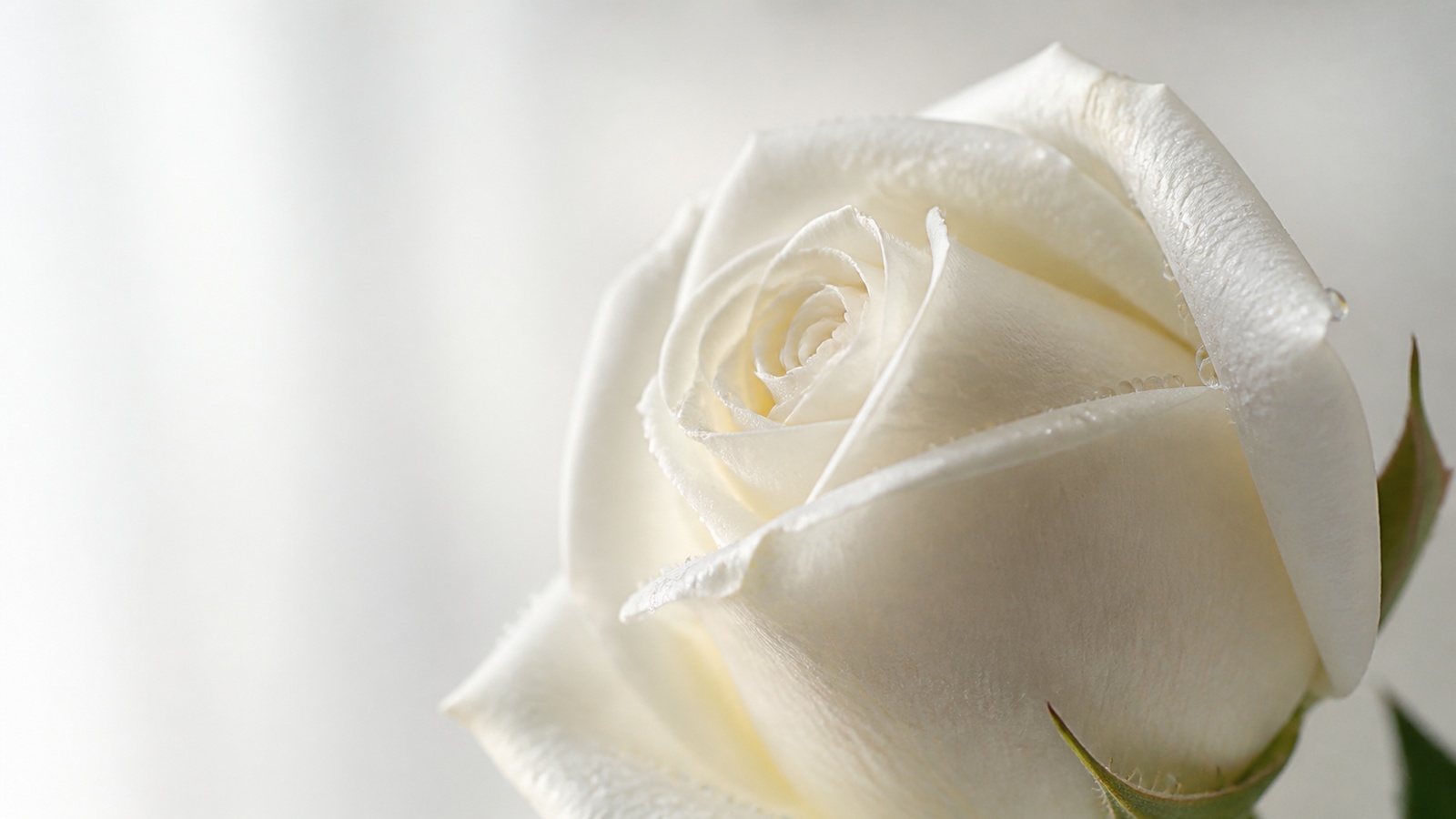
Serious — yes. But not in the way most people think. Here's the actual breakdown of what white roses really mean, when they should be given, whom they suit, and why the "only for funerals" myth is a cultural misunderstanding.
Where the "cold" reputation comes from
The funeral association is largely a regional thing — strong in some Eastern European traditions where, historically, white flowers were the default for funeral compositions because coloured alternatives were scarce. In parallel, white roses have always been given to brides at weddings, but the second association didn't make it into mass consciousness in those regions.
In Western and global florist tradition, the white rose is:
- Symbol number one for weddings — used at almost every ceremony worldwide
- Second — motherly love (in the United States, Mother's Day is often marked with white roses)
- Third — peace and pacifism (for example, the anti-Nazi "White Rose" resistance group in Germany, 1942)
Globally, white roses stand for:
- Purity of the relationship (wedding, engagement)
- New beginnings (opening something important, moving, starting a new job)
- Respect without flirtation (teacher, mentor, mother)
- Unconditional love (the kind that expects nothing in return)
And only in a very narrow context — large ceremonial mourning events — are white roses used as part of a funeral composition. And even then, usually not alone, but combined with lilies or chrysanthemums. A single bouquet of white roses on its own does not read as a funeral flower.
When to give white roses — five working scenarios
Weddings and engagements
Here there is no debate — this is the classic. The bridal bouquet is white in 60–70% of cases, and that's not by accident. White is neutral against the dress, doesn't "burn" it in photos, reads as purity of union, agreement, beginning. For an engagement — the same, plus a statement of "I am serious."
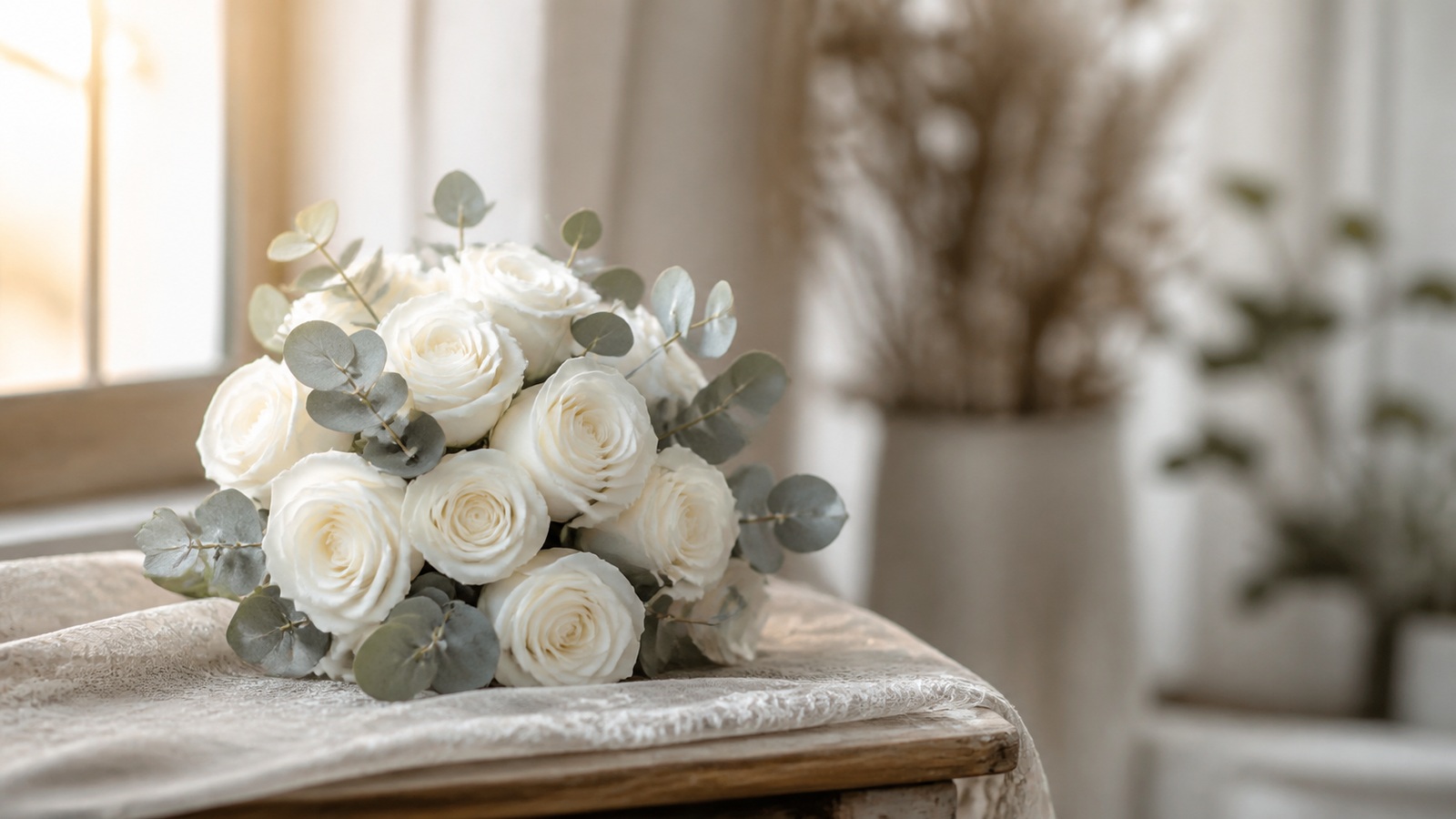
In a wedding bouquet, white roses are usually paired with gypsophila, eucalyptus, lisianthus or ranunculus — this gives texture and volume without a bright colour statement.
Mother — especially over 50
This is a nuanced one. When a man comes in and says "something for mom, but not banal," we suggest white roses with textured green accents (eucalyptus, ruscus). It reads as "an adult son's respect for an adult woman," not as "here are some flowers, mom." It works especially well for milestone birthdays and Mother's Day.
Teacher, mentor, doctor
Graduation, teacher appreciation days, gestures of thanks — white roses are perfect here. They say "thank you for what you do" without flirtation, without innuendo. Especially appropriate if you are a man giving flowers to a female teacher: red roses would be ambiguous, but white roses are correct.
Apology — with a caveat
Handle this carefully. If you've messed up seriously and want to ask for forgiveness — white roses work, but only if there is no "wedding" subtext in your history. For instance, a husband after an argument — yes. A boyfriend after a first serious quarrel with his girlfriend — a pastel peony or lisianthus works better, because white roses can read as "let's just get married and forget about it." Mother-in-law after a fight with the daughter-in-law — yes, an excellent choice.
Without an occasion — as "I appreciate you"
This is our favourite scenario. White roses without an occasion are the strongest gesture in an affordable price range. Not an anniversary, not a birthday, not an apology, not a wedding. Just white roses brought on a random Wednesday evening. That reads as very unexpected and very valuable, even if the bouquet cost only $30.
Varieties of white roses and how they differ
In the flower base we work with five main varieties:
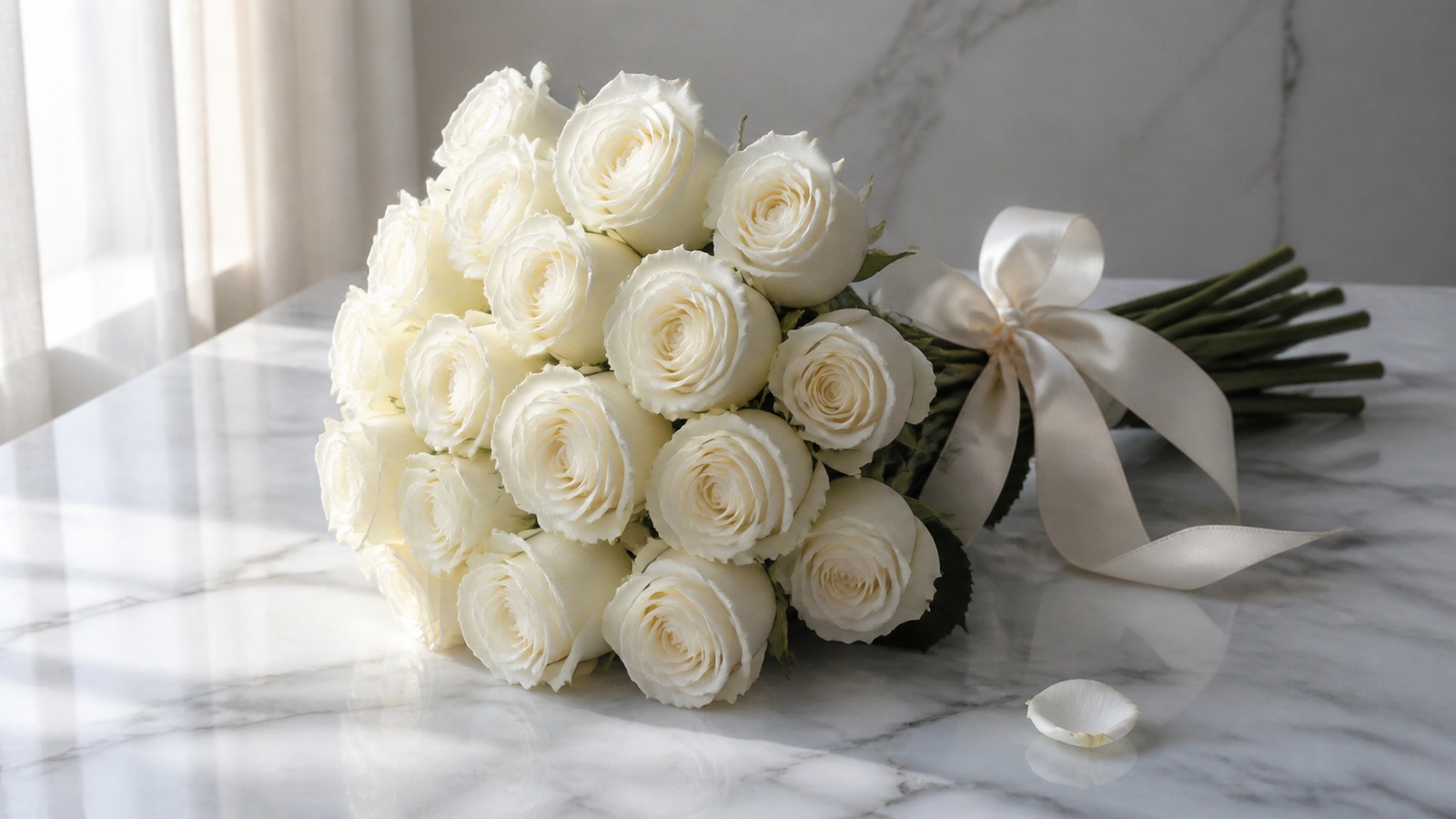
- Avalanche — a large dense bud, pure white with a slightly cream centre. The most recognisable. Retail price: $2–3 per stem.
- Mondial — larger than Avalanche, waxy-looking petals, very dense. More expensive ($3–4), but lives longer (10–14 days).
- Anastasia — a large white rose with a green eye in the centre. Striking, slightly "wedding-like."
- Akito — smaller, tidy, a classic "bouquet" rose. Good in compositions.
- Snow White — with a subtle green undertone in the petals, looks "alive," not plastic.
If budget is tight — go for Akito or Avalanche. If a premium presentation matters — Mondial. If the bouquet is for a wedding or an important event — Anastasia.
What to pair with white roses
The most common mistake is to gather only white roses and then wonder why the bouquet looks "clinical." White roses love company. A base pairing set:
- Silver eucalyptus — adds texture and a light mist
- Gypsophila — creates a "pillow of cloud" around the roses
- White or cream ranunculus — softness, petal-fog
- White lisianthus (eustoma) — an elegant second layer
- White hydrangea — volume for larger bouquets
- Matthiola — adds fragrance
- Ruscus or pittosporum branches — structural greenery
What to avoid — yellow accents (they create a canonical funeral palette) and very dark greenery without silver (visually weighs things down).
Caring for white roses — three nuances you don't get with coloured ones
White roses are the most delicate roses when it comes to aging. Key points:
- Petals brown faster than in red or pink varieties. Any micro-damage — pressure in packaging, a water droplet landing on a petal — will cause a brown spot within 6–12 hours. So when unpacking — don't touch the buds with your fingers.
- Chlorine in tap water shows on the petals more strongly. If your tap water has a noticeable chlorine smell, let it sit for an hour or use filtered water.
- Direct sunlight is a death sentence. On a south-facing windowsill in summer, a bouquet of white roses will collapse in a day.
The rest of the care is standard (diagonal cut under water every two days, water changes, removing leaves below the waterline).
When NOT to give white roses
A few situations where a different colour is a better choice:
- A young woman on a first date — will read as "too serious." Take pink or coral
- A female colleague at a corporate event — too intimate; white roses feel outside professional bounds. Take pastel or bright colours
- A close friend of the opposite sex on their birthday — may read ambiguously
- Combined with red roses in one bouquet — the symbolism of "love and death" (as read in parts of Western folk tradition); it's better not to mix them
How many to give
Standard practice varies by culture:
- In parts of Eastern Europe and post-Soviet countries — an odd number is expected (5, 7, 11, 15, 21). Even numbers are associated with funerals in those regions.
- In most of Western Europe, North America and Asia — either count works.
If in doubt about the recipient's cultural background — stick to odd numbers, they're safe globally. For white roses, the most "working" counts are 11 or 15. Five looks sparse. Twenty-five or more feels too grand except for a wedding.
Summary — who suits white roses
In short:
- Bride — yes, always
- Mother over 50 — yes, especially with green texture
- Teacher or doctor — yes, tactful and correct
- Wife after a long argument — yes, as a symbol of "let's start again"
- Without an occasion — yes, the strongest gesture
- A young woman for flirtation — no, use coloured
- At a memorial event — yes, but not alone, use in composition
White roses are not "cold." They are serious. And that is their strength.
If you want to choose a bouquet of white roses with delivery — we have ready compositions for every occasion, from a mono-bouquet to a wedding armful. Order white roses with delivery — checkout in 5 minutes, delivery from one hour.
If you have questions about the symbolism of other flowers, drop them in the comments — we'll break them down in the next articles.
— Sofia Bell