"Is a groom's boutonniere actually mandatory? And how do we make it 'match' the bouquet?"
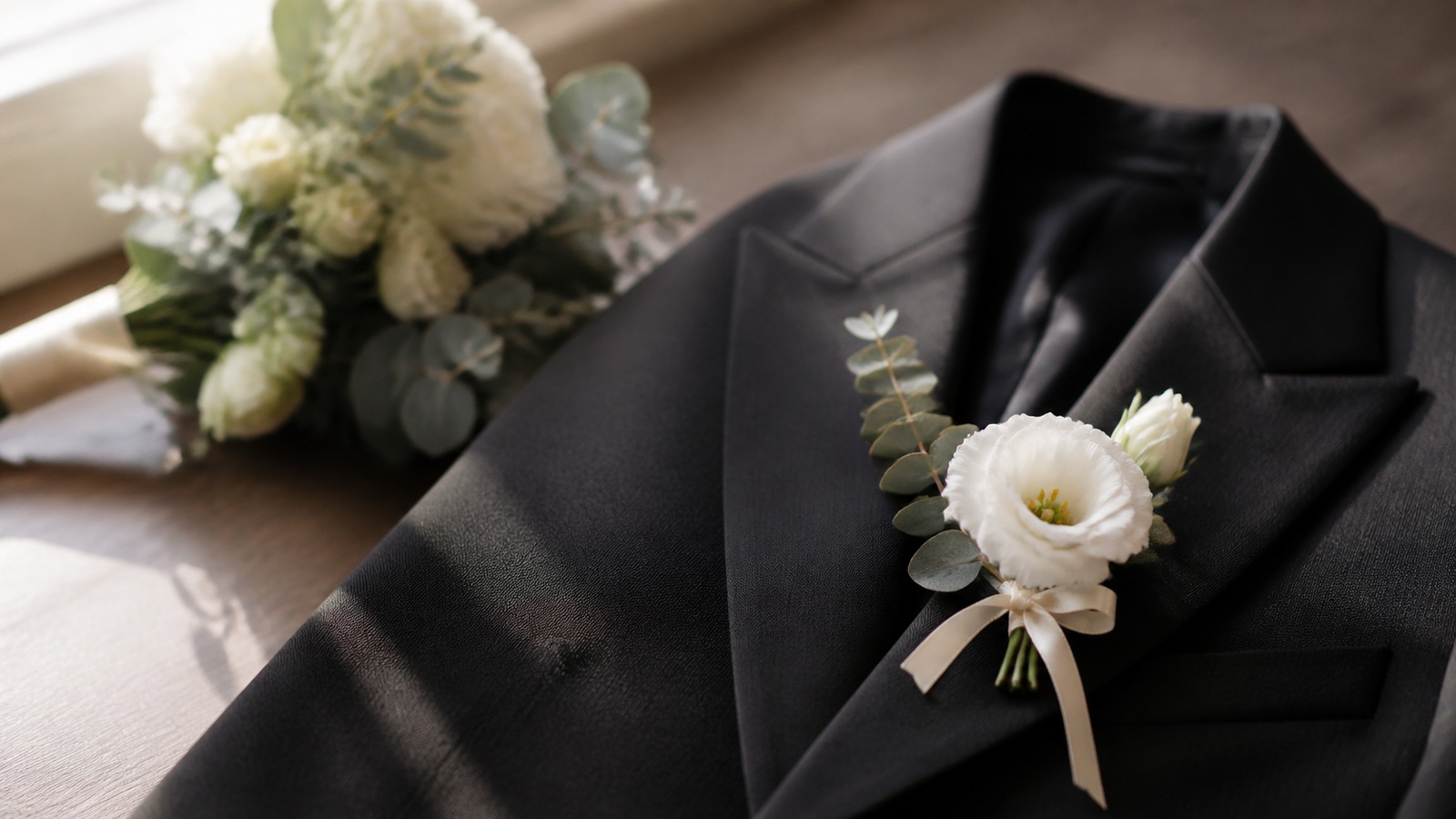
We hear this question at one in three weddings. Especially from couples planning a wedding for the first time (90% of our clients). Nobody understands what a boutonniere is, whether they need one, or how it should look.
Here's everything about this small but important element of wedding floristry. Eight years of work, 400+ brides in the portfolio.
The basics — what a boutonniere is
A boutonniere is a small floral composition worn by the groom on the left lapel of the jacket (where menswear traditionally has a buttonhole for a flower).
Composition:
- 1 focal flower (usually the same one used in the bridal bouquet)
- 1–2 small accent elements (a smaller bud, a sprig of greenery)
- Ribbon or decorative twine
Size: 8–12 cm tall, 4–6 cm wide.
Weight: 30–50 g (important — the lapel shouldn't sag).
Why it matters
1. Visual link between groom and bride
A boutonniere does something words can't: it ties the couple together on camera and in person with a shared floral note. Bride with bouquet + groom with boutonniere = one unit in every photo.
Without a boutonniere, the groom looks "separate from the wedding" — he's in a suit, but aesthetically disconnected from the bouquet, the arch, the table decor.
2. A visual marker
At large weddings with dozens of guests in suits, the boutonniere is a visual marker: "this is the groom." Especially useful at corporate, political, or multicultural weddings.
3. Part of the wedding series
The boutonniere is one of four elements in the wedding floral series:
- Bridal bouquet
- Groom's boutonniere
- Bridesmaids' bouquets
- Boutonnieres for groomsmen and close family
All four are built from a single palette, from the same varieties, so the wedding reads as a coherent piece of work.
How to coordinate the boutonniere with the bouquet
Principle 1: one focal flower
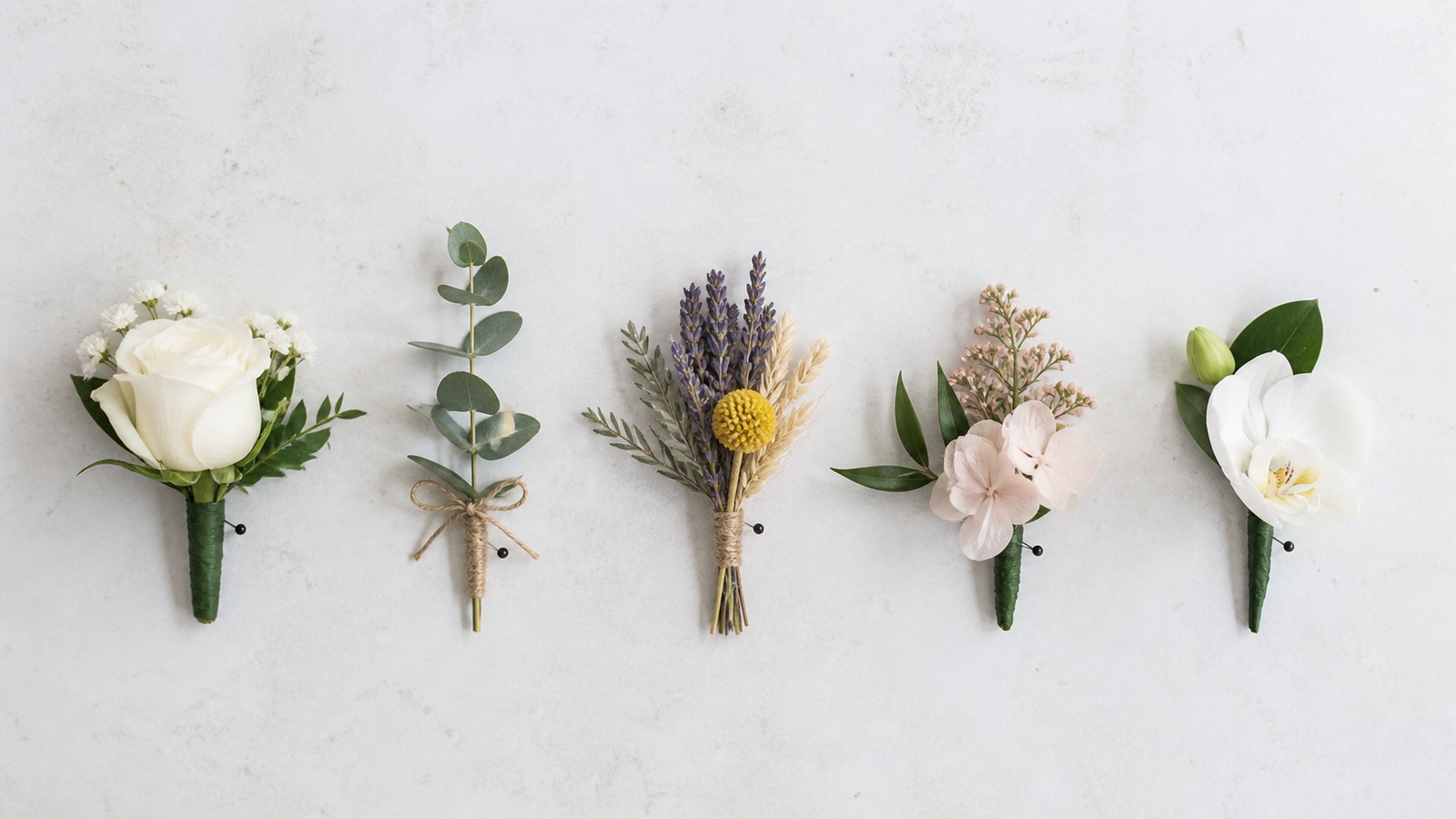
The boutonniere carries one focal flower (not three, not five). That flower must appear in the bridal bouquet — that's how the visual link works.
If the bouquet's focal flower is a peony, the boutonniere is also a peony (one, small). If it's a hydrangea — hydrangea. And so on.
Principle 2: matching palette
Boutonniere color = dominant color of the bouquet. Not contrasting — tone on tone. If the bouquet is pastel, the boutonniere is in the same pastel.
Never:
- White bouquet, red boutonniere
- Pink bouquet, yellow boutonniere
- Pastel bouquet, bright green boutonniere
Principle 3: size shouldn't overwhelm the lapel
The boutonniere should be elegant, not bulky. If it's over 12 cm or thicker than 3 cm, the groom looks "over-decorated."
Ideal proportion: the boutonniere occupies 15–20% of the lapel's height.
Which flowers work best
Best varieties for a boutonniere
Top 1: Lisianthus (eustoma)
- Small bloom size
- Long-lasting (4–6 hours)
- Rich palette (white, cream, dusty pink, lavender)
- Doesn't stain fabric
Top 2: Spray rose
- Just the right size for a boutonniere
- Rich palette
- Hardy
- Works across every wedding style
Top 3: Phalaenopsis orchid (single bloom)
- Very minimal and premium
- Extremely hardy — no wilting for 8 hours
- Great for modern minimalist weddings
Top 4: Hydrangea (miniature)
- Small hydrangea florets sit beautifully
- 2026 palette (dusty pink, smoky blue)
Top 5: Wild stems (for boho)
- Craspedia, lagurus, lavender
- For beach, forest, rustic weddings
Varieties that DON'T work
- Peony — too heavy, will droop the lapel. Only closed buds are acceptable
- Gerbera — too bright, "childish" aesthetic
- Tulip — too long, sticks out awkwardly
- Large single-head chrysanthemum — too big
- Sunflower — too heavy
How to fasten a boutonniere
Three methods:
1. Safety pin (classic)
The traditional method. The boutonniere is pierced at the base and the pin passes through the jacket fabric from inside.
Pros: secure, won't shift.
Cons: leaves a mark on the jacket (matters if the suit is rented).
2. Magnetic mount (modern)
Magnets — one in the boutonniere, one behind the lapel. They snap through the fabric.
Pros: no damage, easy to remove.
Cons: can pop off under strong movement (dancing, hugs). Boutonnieres get lost this way often.
3. Clear line + lapel buttonhole
The boutonniere is tied with clear fishing line threaded through the lapel buttonhole.
Pros: invisible fastening.
Cons: only works with a classic suit that actually has a functional buttonhole.
When to hand the boutonniere to the groom
An underappreciated logistics point.
- 30 minutes before the photo session — no earlier. Otherwise the flower "tires" and loses shape
- Store it in a cooler until handover (with a wet floral sponge at the base)
- Do not remove it from the box until it's being pinned
If the wedding has 4 "phases" (photos — ceremony — reception — dancing), we often prepare two boutonnieres for the groom. One for the first 4 hours, a second for evening dancing. Especially at summer weddings.
Pricing
A single groom's boutonniere — base minimum: $12–18.
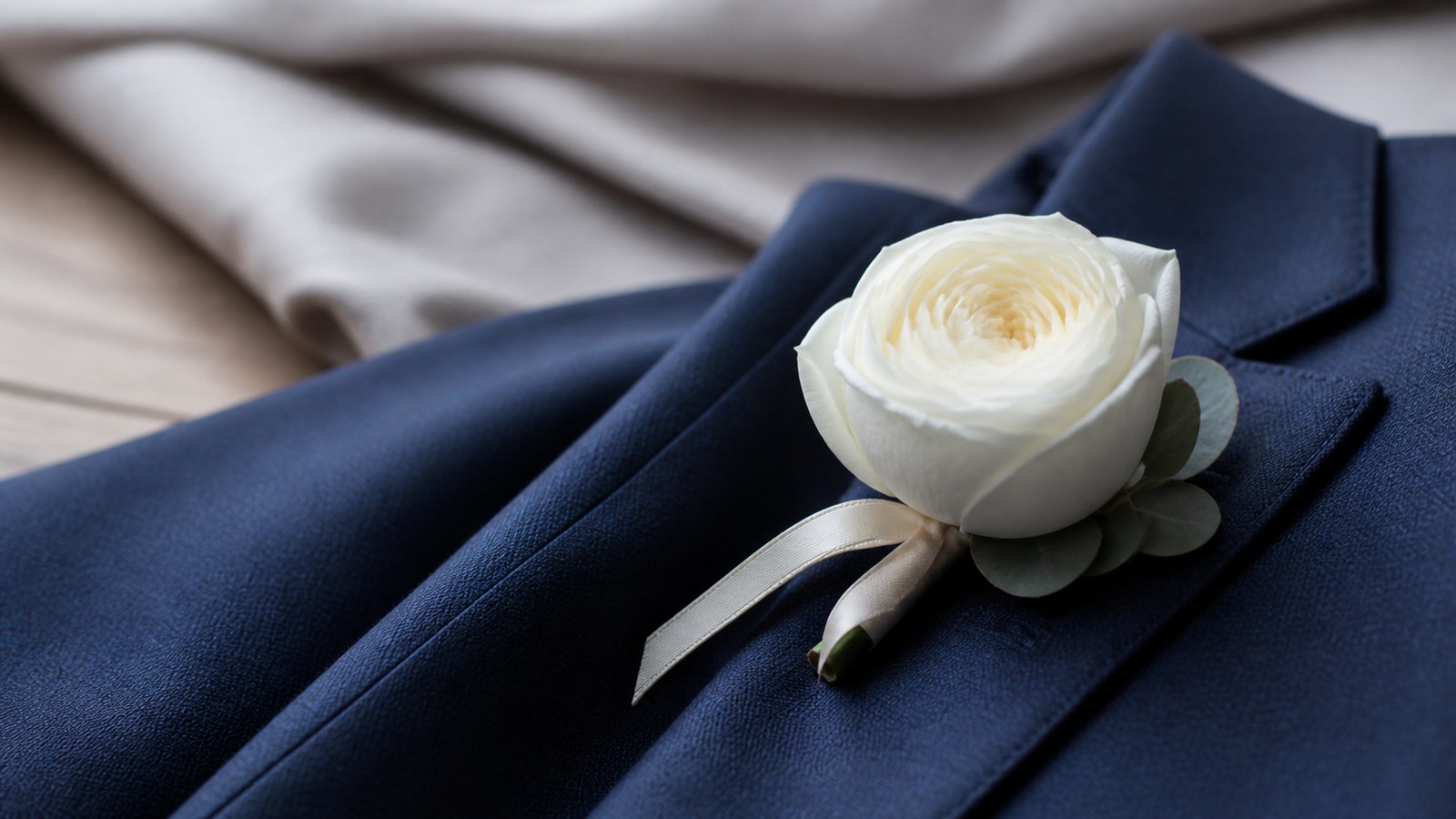
For a full wedding series (groom's boutonniere + 2–4 groomsmen + bridal bouquet + bridesmaids' bouquets), the full set typically runs +25–40% on top of the bridal bouquet cost.
Example:
- Bridal bouquet: $240
- Groom's boutonniere: $16
- 2 groomsmen boutonnieres: $24
- 2 bridesmaids' posies: $80
- Full wedding series: ~$360
"Boutonniere works" checklist
- Focal flower matches the bridal bouquet
- Palette tones with the bouquet (not contrasting!)
- Size 8–12 cm (not bulky)
- Hardy variety (lisianthus, spray rose, orchid)
- Finished boutonniere stored cold until photos
- Fastening decided in advance (pin / magnet / thread)
- For summer — two boutonnieres (day + evening)
What NOT to do
- Don't make it yourself on the wedding day. A boutonniere looks simple; without practice you end up with "a wilted shrub." Order it as part of the wedding package.
- Don't try to save by buying at the corner shop. Quality = disappointment. The boutonniere must come from the same varieties as the bridal bouquet. That's coordination work.
- Don't make it a bright accent. A boutonniere is a note, not a "concerto." If it "outshouts" the suit, it's a bad boutonniere.
- Don't wear the day-boutonniere in the evening if two were made. Use them by scenario. Don't "wear now, swap later."
If you're planning a wedding
In our wedding packages the groom's boutonniere is included with the bridal bouquet (no separate charge). Groomsmen boutonnieres and bridesmaids' posies are billed separately but built in the same palette, same varieties, coordinated.
Wedding floristry with delivery — booked 2 months in advance, first consultation free.
— Sofia Bell