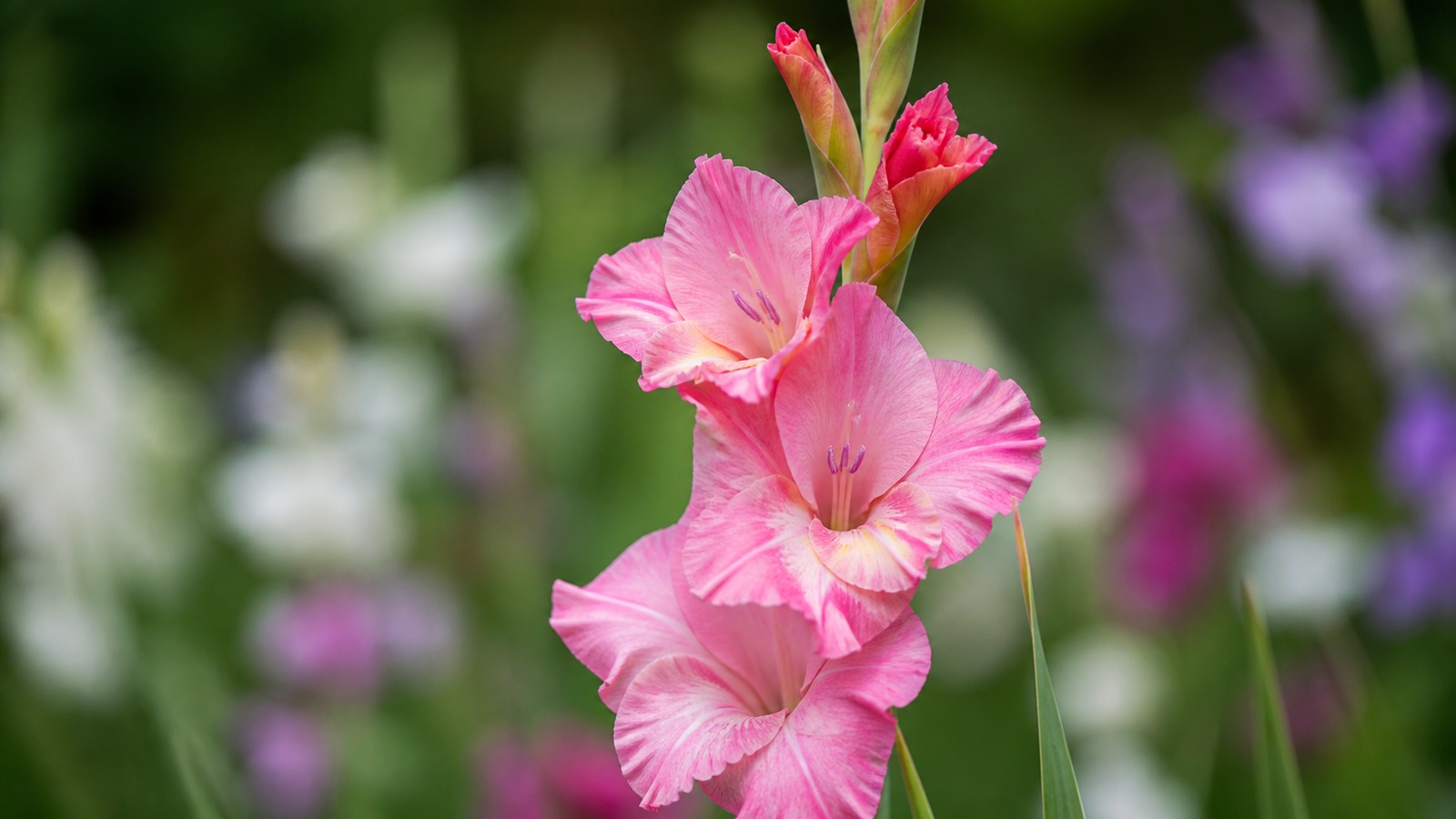
Gladiolus is a flower with a biography from the Roman amphitheater to the modern first-graders' bouquet. The tall spike opens bottom-up over 8–12 days; on one stem, 4–7 flowers up to 18 cm across are simultaneously open. Varieties differ in petal ruffling, flower size, and days to bloom — from 75 to 105 days from planting. Here we cover botany, five-class classification, forcing for September 1, bouquet techniques, and corm care.
Botany and history
Gladiolus is a genus in the Iridaceae family — about 280 species. The Latin name is a diminutive of gladius (sword), a direct analogy: the long sword-shaped leaf and straight scape with one-sided flowers really do resemble a blade. In Russian the plant is also called shpazhnik.
In the wild the genus spans the Mediterranean, the Caucasus, and southern Africa. 20th-century breeding worked almost exclusively with South African species: G. dalenii, G. cardinalis, G. tristis. Modern commercial cultivars are complex hybrids with up to 7 wild species in the pedigree, grouped as Gladiolus × hybridus.
Gladiolus is a corm perennial. The underground part is a corm that is fully replaced each season: the old one dies and a new one forms above it. Commercial corm size 4–6 cm; XL grade — 5 cm+. Scape 80–180 cm depending on cultivar; 5–9 sword-shaped leaves up to 80 cm long. One scape carries 14–28 buds, with 4–7 simultaneously open.
Gladiolus hybrid (Gladiolus × hybridus) A corm perennial 80–180 cm tall. Blooms 8–12 days. Flower size from 6 cm (mini) to 18 cm (giant). Vase life 7–10 days. Medium cold-hardiness (to −5 °C); in temperate zones corms are lifted for winter. Propagated by cormlets and cuttings.
Classification and popular varieties
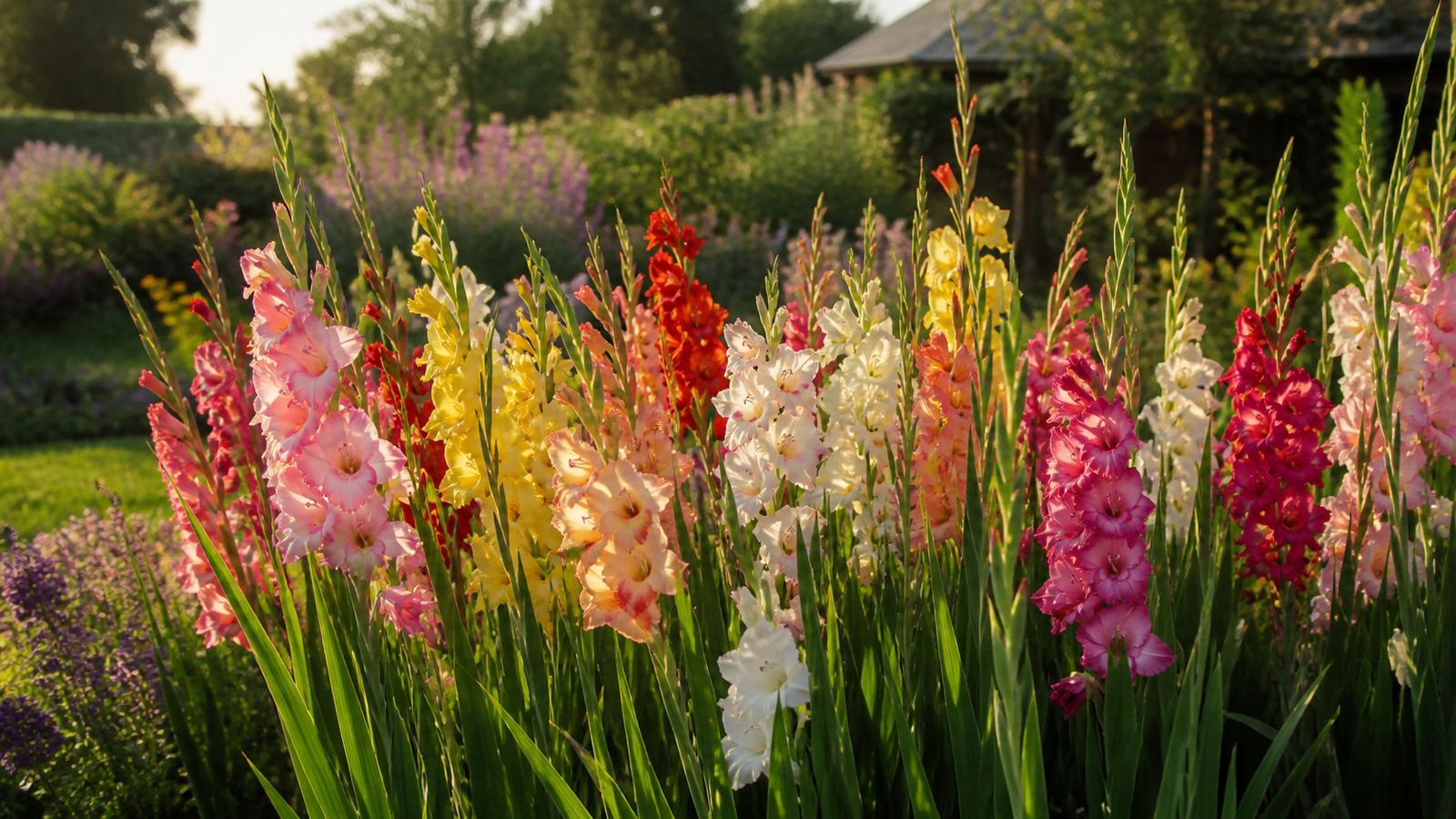
International classification (NAGC) uses 5 size grades:
- Miniature (400) — flower size to 6 cm
- Small (400) — 6–9 cm
- Medium (400) — 9–12 cm
- Large (400) — 12–14 cm
- Giant (500) — 14–18 cm
Additional label: 3-digit color code + 2-digit ruffle grade + size class. So "Giant 502-32" = giant size, ruffled, red color.
Best cut varieties
White:
- Priscilla — pure white with a delicate pink center
- Amsterdam — snow white, universal
- White Prosperity — the classic wedding gladiolus
Pink:
- Green Star — cream with green tips
- Pink Prosperity — soft pink, doubled
- My Love — deep pink
Red and burgundy:
- Espresso — coffee-red
- Black Star — near-black burgundy
- Zorro — bright red
Yellow and orange:
- Nova Lux — clear lemon yellow
- Peter Pears — soft peach
- Jester — bicolor yellow-red
Multicolor:
- Boone — pink with a red center
- Passos — orange-red with a yellow throat
- Purple Prince — purple
Planting the corms
Timing: mid-April to end of May, when soil at 10 cm warms to +10 °C.
Depth: 3× corm height. For a 5 cm corm — 15 cm deep. Spacing: 15–20 cm.
Position: sun, drained soil pH 6.5–7.0. On heavy clay, add sand at the bottom of the planting hole.
Pre-planting soak: hold corms in a fungicide solution (Maxim, 4 ml per 2 L) for 30 minutes to prevent Fusarium.
Feeding at planting: 30 g superphosphate + 20 g potassium sulfate per m². Nitrogen only after emergence.
Season care
- After emergence: 20 g ammonium nitrate per m² + 15 g potassium
- At bud stage: N-P-K mix 25 g/m²
- After bloom: superphosphate 40 g/m² for corm ripening
- Watering: moderate but consistent, especially at bud emergence
- Staking: tall varieties (150 cm+) need staking — one bamboo per stem
- Diseases: thrips (Actara), Fusarium (fungicide seed treatment), leaf spot
Lifting and winter storage
Corms are lifted 30–45 days after bloom, typically September–October, when the top has yellowed.
- Cut the top 2 cm above the corm
- Dry the corm at +20 °C for 15–20 days
- Peel the old scales
- Store at +5…+10 °C, humidity 60–70% (paper bags, sawdust)
- Check monthly for rot
Gladiolus in bouquets
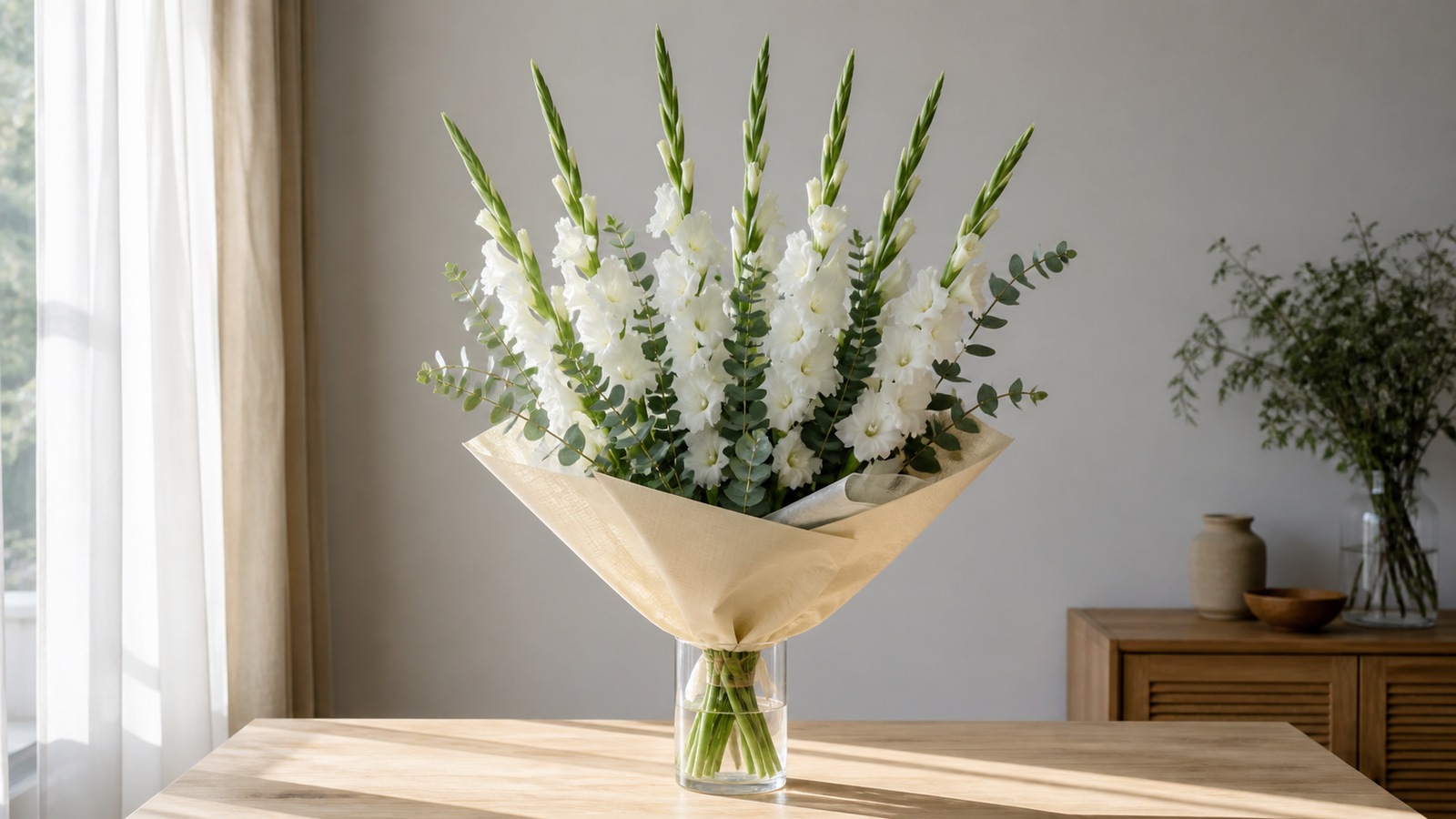
Gladiolus is a florist's "vertical" tool. Not for compact bouquets — for tall statement compositions.
Working combinations
- Gladiolus + hydrangea + ruscus (banquet centerpiece)
- Gladiolus + gerbera + eucalyptus ("teacher's bouquet" for September 1)
- Peach gladiolus + rose + wheat (autumn wedding)
- White gladiolus + calla + orchid (statement wedding arrangement)
Combinations that don't work
- Gladiolus + tulip (scale mismatch — tulip disappears)
- Gladiolus + peony (peony competes for focus)
- Gladiolus + wildflowers (aesthetic clash)
Cut care
- Cut when 2–3 lower buds show color
- Trim at 45° under water at intake
- Vertical vase — critical, otherwise the stem bends
- Change water every 2 days
- Add flower food
- Remove faded lower florets — the upper buds keep opening
- Bend correction — if the stem curves, plunge horizontally into water for 12 hours
Vase life: 7–10 days on the stem; on multi-branching cultivars — up to 14.
Symbolism and history
The gladiolus is named for the Roman gladiator. Roman legend says two friends, Sævt and Teres, refused to fight each other in the arena and were both killed by the emperor; their swords dropped and turned into gladiolus flowers on the amphitheater sand.
Meaning by color:
- Red — passion, chivalric loyalty, admiration
- White — nobility, purity, respect
- Pink — tender feelings, maternal love
- Yellow — friendship, gratitude
- Purple — dignity, admiration for a mentor
In the language of flowers gladiolus means "you have pierced my heart" — a symbol of strong feeling that couldn't be expressed openly. In modern culture (especially post-Soviet) gladiolus is associated with "September 1" (school year start) and teacher gifts.
Facts and FAQ
- Roman origin. Gladiolus corms were part of ancient Roman soldiers' first aid — mashed with wheat flour and used as an antiseptic poultice.
- The Grateful Dead flower. The gladiolus is the official flower of the American state of Georgia and is prominently featured in Grateful Dead concert posters.
- August birth-flower. The gladiolus is the traditional American birth-flower for August births.
- Record height. The tallest gladiolus recorded — 2.6 m in Canada, 2001, cultivar "Boone Special."
- Van Gogh painted them. Vincent van Gogh painted gladioli in three canvases in 1886.
FAQ
Can I gift gladiolus to a woman under 40? Careful — for younger recipients gladiolus can read as "provincial" or "grandmother's." Better as an accent in a modern composition or replaced with snapdragons.
How to keep gladiolus straight? Vertical narrow vase, remove faded lower florets, plunge horizontally in water if it bends.
Which color for a teacher gift? Pink or peach — soft classic. White — formal. Red — passionate. Yellow — friendship.
When do gladioli bloom in the garden? July–September, 75–105 days after planting.
Budget? Cut gladiolus stem: $2.50–4.50. Bouquet of 7 gladioli: $30–50. Wedding tall arrangement: $150–320.
Are gladioli poisonous? All parts are mildly toxic to cats and dogs; corms cause vomiting if ingested. Keep away from pets.
Want a bouquet with gladioli? Browse the catalogue — 30+ cultivars, in season July to October.
Summary: gladiolus is a florist's vertical tool. Tall statement stems, huge color palette, 7–10 days in the vase. Best in banquet arrangements, autumn weddings, and "teacher-classic" bouquets. Key rule: vertical narrow vase; remove faded lower florets to keep the top opening.
— Sofia Bell
Author
Sofia Bell
Florist and blog editor