Freesia is the only flower that smells simultaneously of fruit and crème brûlée. Its scent appears in three dozen world perfumes — Diptyque Ofresia to Marc Jacobs Daisy. The stem carries 5–9 tubular flowers opening bottom-up like a gladiolus. Vase life 8–14 days — the longest of any strongly-scented flower. Here's the varieties, color groups, forcing, cut-flower care, and wedding floristry.
Botany and history
Freesia is a genus in Iridaceae, about 16 species. Native to South Africa's Cape Province, where it blooms July–September (South African "spring"). Named in 1866 by the Danish botanist Christian Friedrich Ecklon after his friend, the botanist-physician Friedrich Heinrich Theodor Freese.
The modern freesia is a complex hybrid Freesia × hybrida with four wild species in its pedigree: F. refracta, F. corymbosa, F. armstrongii, F. leichtlinii. Industrial breeding began in the Netherlands in the 1930s; today 350+ varieties are on the market. Main global producers: Netherlands (60% of cut market), Kenya, Colombia, Israel.
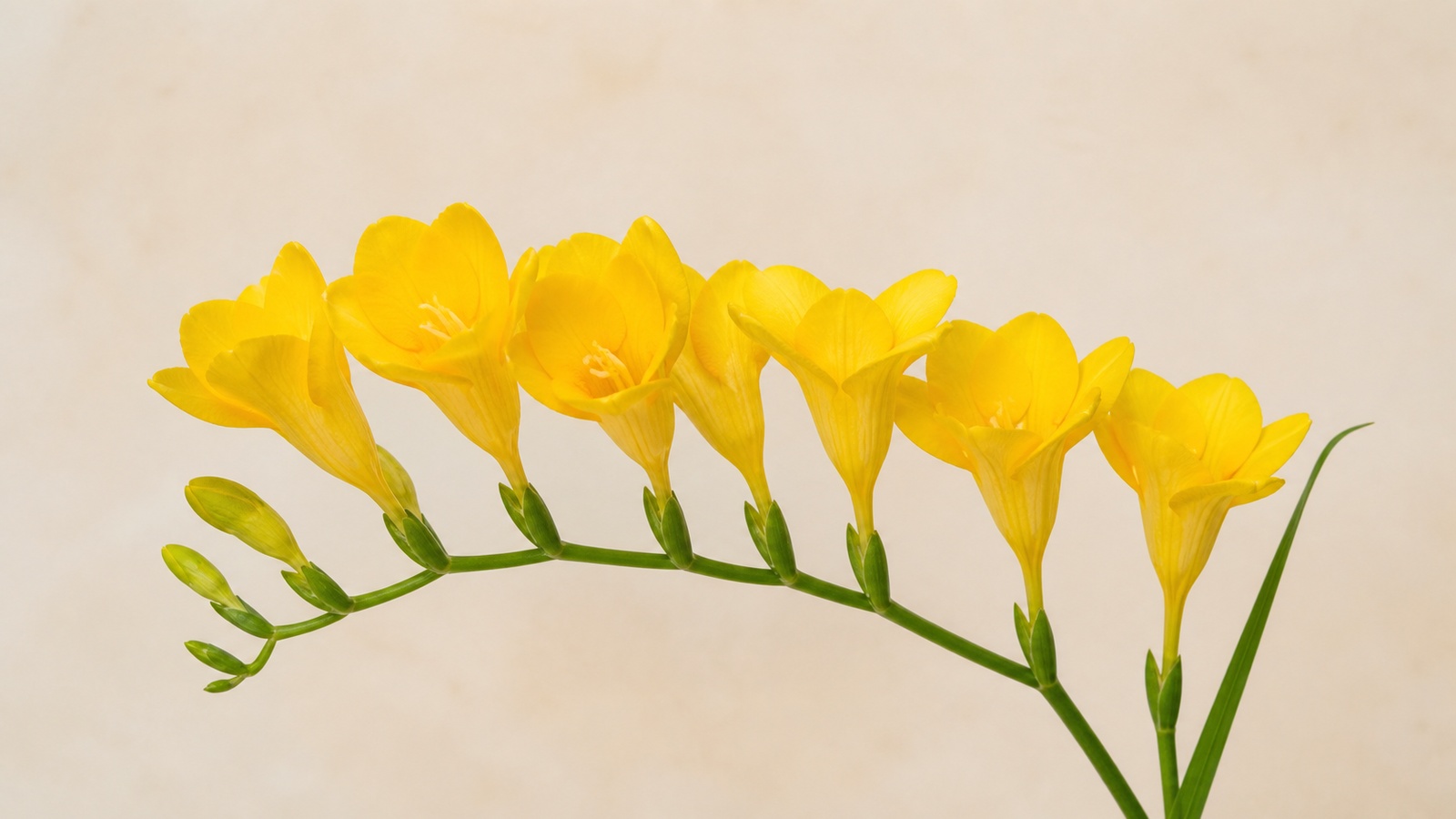
The underground part is a corm 1.5–3 cm across (like gladiolus), replaced each season. Scape 30–60 cm tall, 5–7 sword-shaped leaves up to 25 cm long. Inflorescence — a one-sided spike: 5–9 tubular flowers with six petals opening bottom-up. Flower size 4–6 cm. Freesias come in single and double forms (12–18 petals, the "Double" series).
Hybrid freesia (Freesia × hybrida) Corm perennial 30–60 cm tall. 5–9 flowers 4–6 cm on the stem. Vase life 8–14 days. One of the most fragrant garden flowers — smells of lemon, honey, and lily of the valley. Zero cold-hardiness — corms are lifted and stored warm.
Varieties and color groups
Modern freesias split into 6 color groups. Choice depends on the palette you want.
White and cream
- Aladdin White — pure white, most popular for weddings
- White River — cream-white, doubled florets
- Alaska — snow-white, single
- Champagne — pale ivory, doubled
Yellow
- Aladdin Gold — bright yellow, classic
- Yvonne — lemon yellow, doubled
- Cybele — golden yellow
Pink and coral
- Pink Fountain — dusty pink
- Rossini — hot pink, doubled
- Coral — coral-peach
Purple and lavender
- Purple Rain — deep purple
- Delft Blue — lavender-blue
- Blue Heaven — pale lavender
Red and burgundy
- Red Beauty — bright red
- Burgundy — deep burgundy, doubled
- Astor — bicolor red-white
Bicolor
- Ambience — cream with pink edges
- Athene — white with purple veins
- Sonora — yellow with red edges
Most in-demand for weddings: white and pastel groups. For "designer" bouquets — bicolor. Yellow — for International Women's Day and spring compositions.
The scent of freesia and perfumery
The freesia scent is a complex bouquet of citrus (limonene), floral (ionones), and gourmand (vanillin) notes. It's this "3-in-1" combination — fruit + flower + dessert — that makes freesia irreplaceable in perfumery.
Famous perfumes with freesia:
- Diptyque Ofresia — a solo freesia composition
- Marc Jacobs Daisy — freesia + violet + jasmine
- Chanel Coco Mademoiselle — freesia as a top-note
- Jo Malone Freesia & Blackcurrant — cologne
- Yves Saint Laurent Y — freesia in the male fragrance
Scent intensity varies by variety. Aladdin White and Yvonne are the most fragrant; some doubled varieties have almost no scent — bred for form, not smell. If you buy freesias for aroma, ask the florist about a fragrance-focused variety.
Freesia in bouquets and weddings
Freesia is a wedding classic. Top three uses:
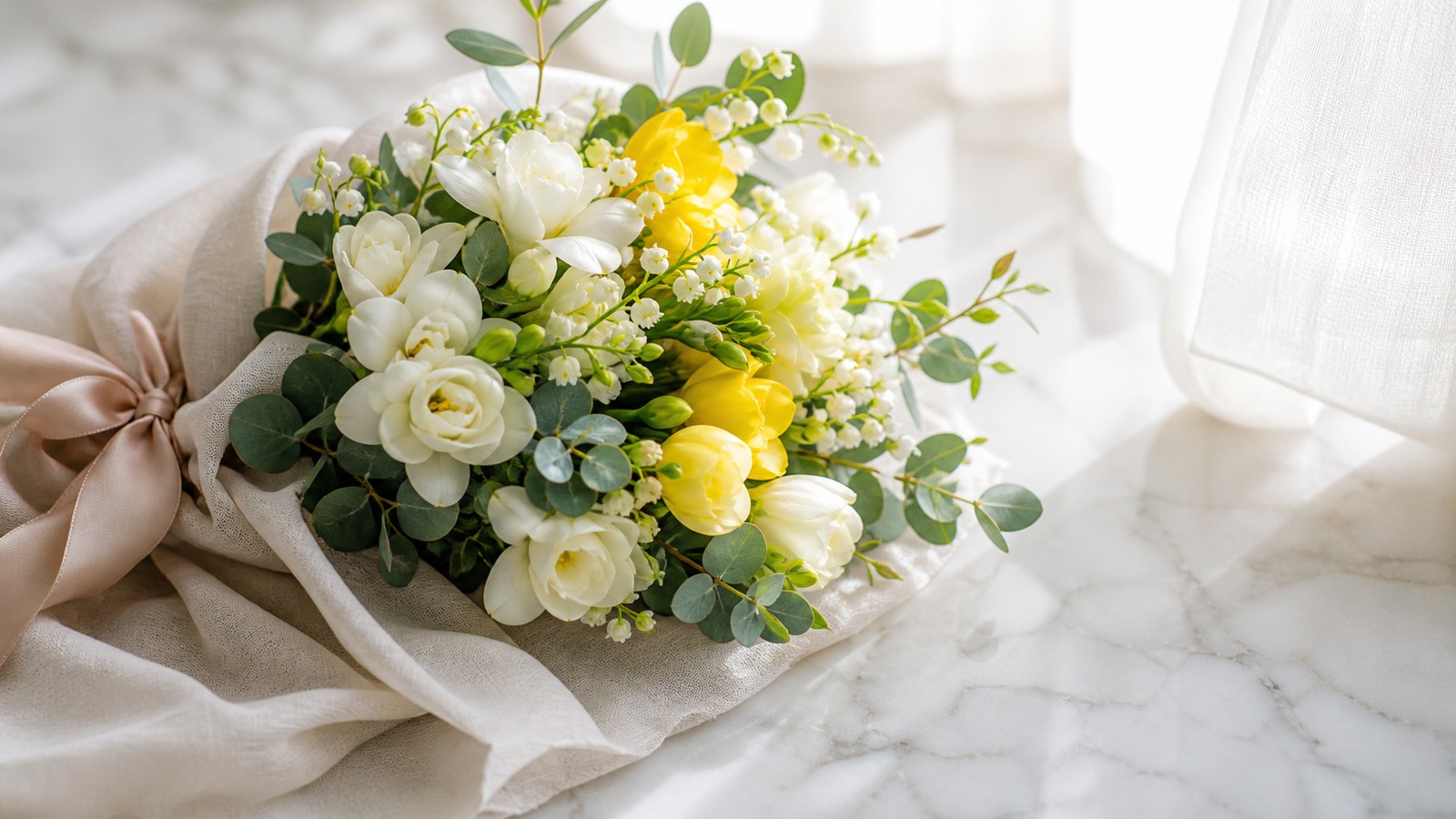
- Bridal bouquet. 15–25 freesia stems in mixed pastel shades create a "fragrant cloud" — the bride and the whole ceremony scent throughout the day.
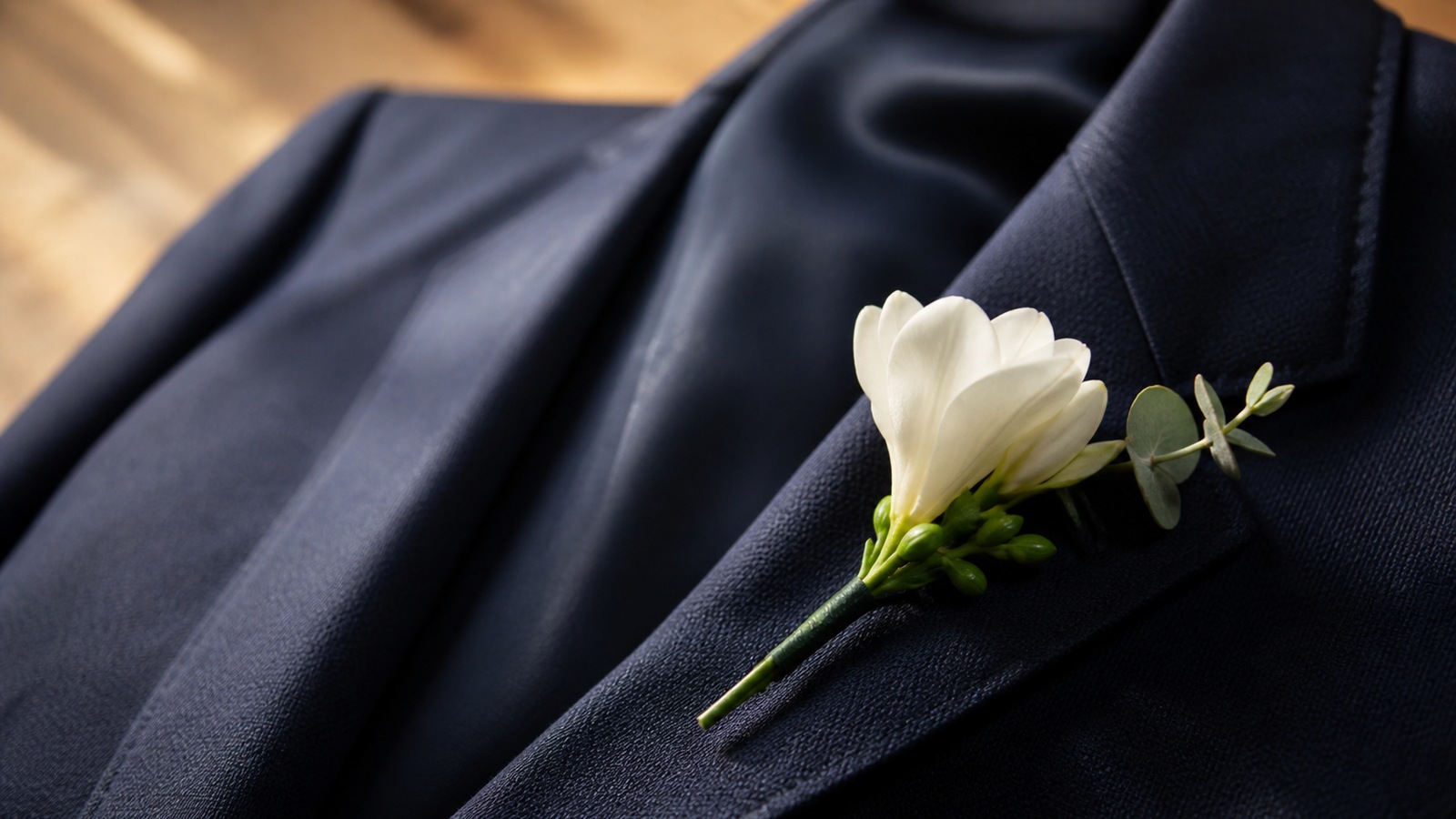
- Boutonnieres. One freesia flower + eucalyptus = the perfect boutonniere for the groom and groomsmen. Freesia holds 6–8 hours without water.
- Aisle arches and table decor. Fragrant freesias distributed along the aisle create a scent trail.
Working combinations
- Freesia + lily of the valley + white lisianthus (spring wedding)
- Yellow freesia + narcissi + tulips (spring bouquet)
- Purple freesia + iris + eryngium (Aquarius-style composition)
- Pink freesia + peony Sarah Bernhardt + ranunculus (romantic bouquet)
Combinations that don't work
- Freesia + lily (lily's scent overpowers freesia)
- Freesia + hyacinth (competing intense scents)
- Freesia + carnation (aesthetic mismatch)
Cut-flower care
Freesia stays fresh longer if the "one-sided spike" trait is respected. Buds open sequentially bottom-up.
- Buy at the stage when the bottom 1–2 buds are showing color, but haven't opened
- Trim at 45° under water, remove any leaves that would sit in the water
- Cool water (12–15 °C), medium-depth vase
- Change water every 2 days
- Add flower food — freesia responds strongly
- Away from ethylene (bananas, apples) — freesia is very ethylene-sensitive
Trick: as the lower flowers finish, trim them off the stem so the upper buds keep opening. Extends the bouquet by 3–4 days.
Vase life: 8–14 days with proper care. In heat — 5–7 days.
Forcing and pot culture
Freesia is a favorite forcing bulb for Christmas and Valentine's Day. Corms are planted in a pot in October, kept at +8…+12 °C for 12 weeks, then moved to warmth. Bloom 6–8 weeks after moving to warm — right on Feb 14.
Pot culture rules:
- Deep narrow pot (12 cm diameter, 20 cm depth)
- Light drained soil with sand
- Temperature +14…+18 °C during bloom
- 6 hours of direct light per day
- Moderate watering, no waterlogging
After bloom, foliage yellows and dies down; the pot is stored dry until next season. Corms multiply — one becomes 3–4 by year's end.
In the open ground
Freesia doesn't overwinter in temperate zones (zero cold-hardiness). Corms are lifted after autumn foliage yellowing and stored at +15…+18 °C, humidity 70%, until next spring planting.
Planting: May, when soil warms to +12 °C. Depth 5–8 cm, spacing 10 cm. Blooms August to September.
Feeding: May — nitrogen (fertilizer for bulbs); at bud stage — potassium magnesium.
Watering: moderate. Waterlogging rots the corms.
Diseases: Fusarium (prevent with fungicide seed treatment before planting), thrips (Actara at first sign).
Symbolism and meaning
In the Victorian language of flowers, freesia meant "trust" and "innocent friendship." The modern interpretation adds "spring freshness," "renewal," "hope."
- White — purity of intent, wedding purity
- Yellow — friendship, sun, joy
- Pink — tender feeling, first sympathy
- Purple — dignity, thoughtfulness
- Red — passion (rare use)
- Bicolor — the "complex feeling" of the recipient
In modern floriography freesia is a "message flower" — a signal you're thinking of the recipient without romantic intensity.
Facts and FAQ
- Named after a person. Freesia is named after the botanist-physician Freese, a friend of the naturalist Ecklon.
- The scent chemistry. Freesia's aroma contains 34 documented compounds — one of the most complex in botany.
- Pisces' floral talisman. Freesia is the primary flower of the zodiac sign Pisces (see Pisces zodiac flower).
- Long-lived on the corm. A single corm can bloom in the garden for 5–7 years without loss of vigor.
- Freesia in wedding photography. The world's most-photographed white bridal freesia bouquet is 'Aladdin White' at the wedding of Prince William and Kate Middleton in 2011.
FAQ
Do freesias always smell? Not always. Doubled varieties are often bred for form and may be almost scentless. For fragrance, request single-form freesia.
How long can one bouquet stay in a vase? 8–14 days with proper care. If you want maximum life, buy at the "color showing but bud closed" stage.
Can freesia grow at home? Yes, as a pot forcing culture. Especially popular for Christmas and Valentine's Day.
Bouquet with freesia — how many stems? 11–21 stems for a mid-size bouquet. Odd numbers work universally.
Which color to choose? White for weddings and mourning. Yellow for teachers and spring gifts. Purple for a Pisces or Aquarius recipient. Pink for a young girlfriend.
Are freesias allergenic? The scent can trigger reactions in the perfume-sensitive. Check with the recipient beforehand.
Want a bouquet with freesias? Browse the catalogue — 30+ varieties, year-round supply.
Summary: freesia is a florist's aromatic magic tool. Long vase life, gentle color, unforgettable scent. Great in a bridal bouquet, a Pisces-recipient gift, or a spring composition. Key rule: check for scent — some varieties are almost odorless.
— Sofia Bell