Every week someone messages: "I dropped aspirin in the water and my bouquet lasted 12 days!" A week later, another: "Someone told me to add bleach — I tried it, the flowers died in a day." And of course: "My grandmother always added sugar, she said it helps."
 Let's settle every internet recipe for good. What actually works from a chemistry standpoint and from 8 years of hands-on work — what does nothing, and what harms.
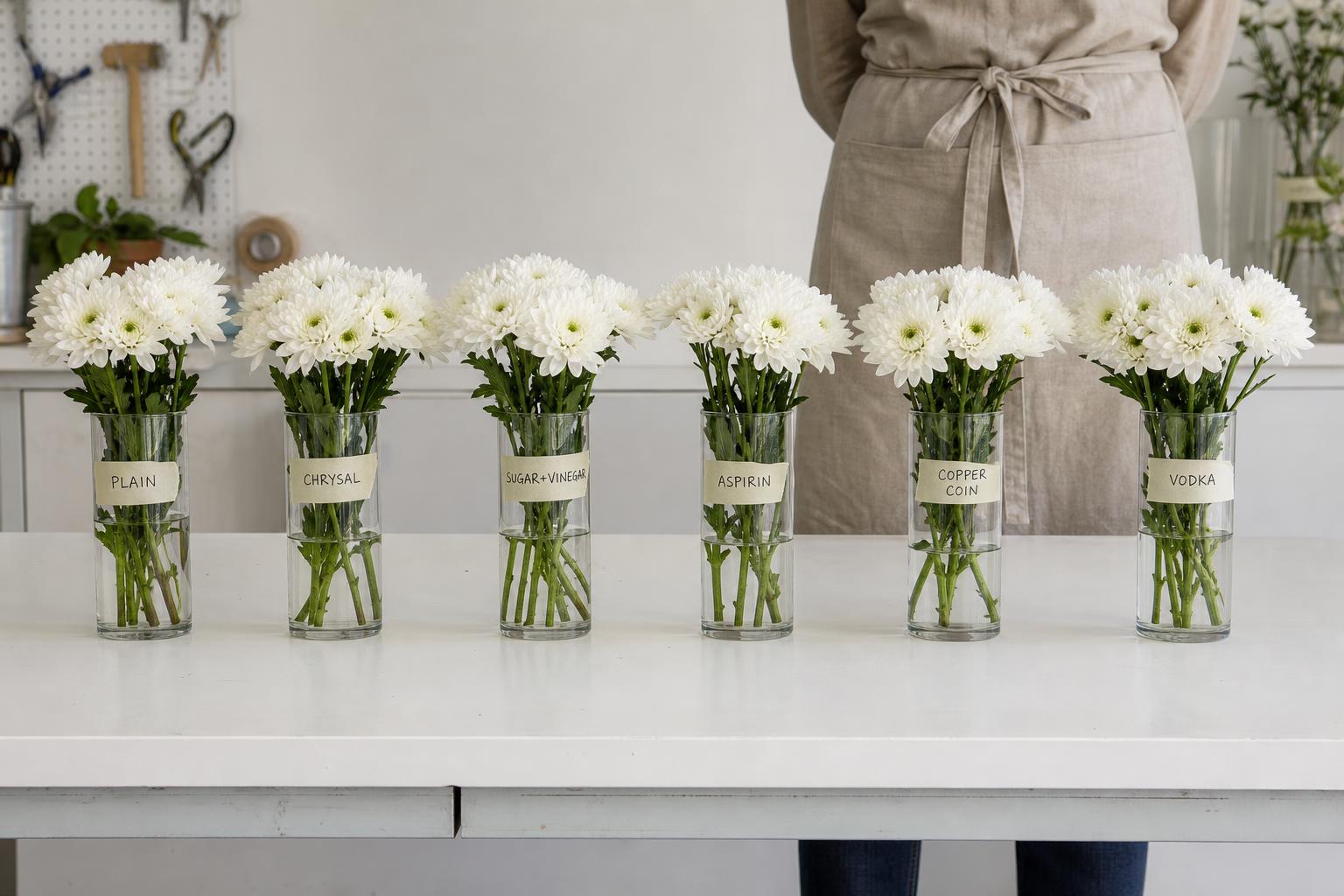
We tested 12 recipes on identical chrysanthemum bouquets in our workshop. Here are the results. No marketing.
Test conditions
To be fair:
- 12 vases, identical, washed
- 3 chrysanthemums in each ('Anastasia' variety), same batch
- Same room temperature (+22 °C)
- Same humidity (~50%)
- Same 45° cut before placing
- Not near sun, no fruit nearby
- Water changed every 2 days on the same schedule
- Observation: 14 days
Result — how many days the flower still looked fresh (no wilting, no petal drop).
Test results
Plain water + nothing
Result: 7 days of freshness.
The control. Without additives, a chrysanthemum lives a week under standard conditions.
Aspirin (1 tablet per 1 L)
Result: 7 days.
No effect. None. Flowers behaved exactly as in plain water. Myth #1 busted.
Chemistry note: aspirin (acetylsalicylic acid) slightly lowers water pH, but at "one tablet per liter" the effect is negligible. It doesn't help the flowers.
Sugar (1 tsp per 1 L)
Result: 6 days (−1 day).
Shortened life. Bacteria got extra food and multiplied faster. Water clouded a day early.
Sugar (1 tsp) + apple cider vinegar (1 tbsp) per 1 L
Result: 9 days (+2 days).
WORKS. Sugar feeds the flowers, vinegar suppresses bacteria. The best "grandmother's recipe."
Vodka (1 tbsp per 1 L)
Result: 4 days (−3 days).
Shortened life significantly. Alcohol burns the stems at the cut, capillaries close, the flower "starves."
Myth: vodka as antiseptic. Reality: vodka kills bacteria — but at 0.5% concentration it already damages plant tissue.
Chlorine bleach (a few drops per 1 L)
Result: 3 days (−4 days).
Disaster. Flowers yellowed, leaves dropped. Absolutely do not do this.
Chlorine reacts aggressively with plant tissue, destroying cell structure.
Copper coin (pure copper only)
Result: 8 days (+1 day).
Weakly effective — only with genuine pure copper. Copper is a mild antiseptic, but the effect is small.
Modern coins do NOT work. Most modern coins are brass or alloy, not pure copper. No effect.
Baking soda (1/4 tsp per 1 L)
Result: 5 days (−2 days).
Shortened life. Soda raises pH; flowers want slightly acidic water (pH 4–5), not alkaline.
Citric acid (1/4 tsp per 1 L)
Result: 8 days (+1 day).
Mildly effective. Citric acid lowers pH; flowers drink better. Weaker than Chrysal, but not zero.
Glycerin (1 tbsp per 1 L)
Result: 5 days (−2 days).
Shortened life. Glycerin raises water viscosity; flowers struggle to absorb it.
Chrysal (1 sachet per 1 L) — professional flower food
Result: 14 days (+7 days!).
ABSOLUTE WINNER. Doubled the bouquet's life.
Chrysal is a professional mix: antiseptic + flower nutrition + pH regulator in the right proportions. Made specifically for cut flowers.
Hydrogen peroxide (1 tbsp of 3% per 1 L)
Result: 8 days (+1 day).
Mildly effective. Peroxide as an antiseptic works, but weakly. In larger doses it damages tissue.
Summary table
| Additive |
Days fresh |
Change |
| Chrysal (professional flower food) |
14 |
+7 |
| Sugar + apple cider vinegar (1:3) |
9 |
+2 |
| Citric acid |
8 |
+1 |
| Hydrogen peroxide |
8 |
+1 |
| Pure copper coin |
8 |
+1 |
| Plain water |
7 |
0 (baseline) |
| Aspirin |
7 |
0 |
| Sugar alone |
6 |
−1 |
| Baking soda |
5 |
−2 |
| Glycerin |
5 |
−2 |
| Vodka |
4 |
−3 |
| Chlorine bleach |
3 |
−4 |
What actually works
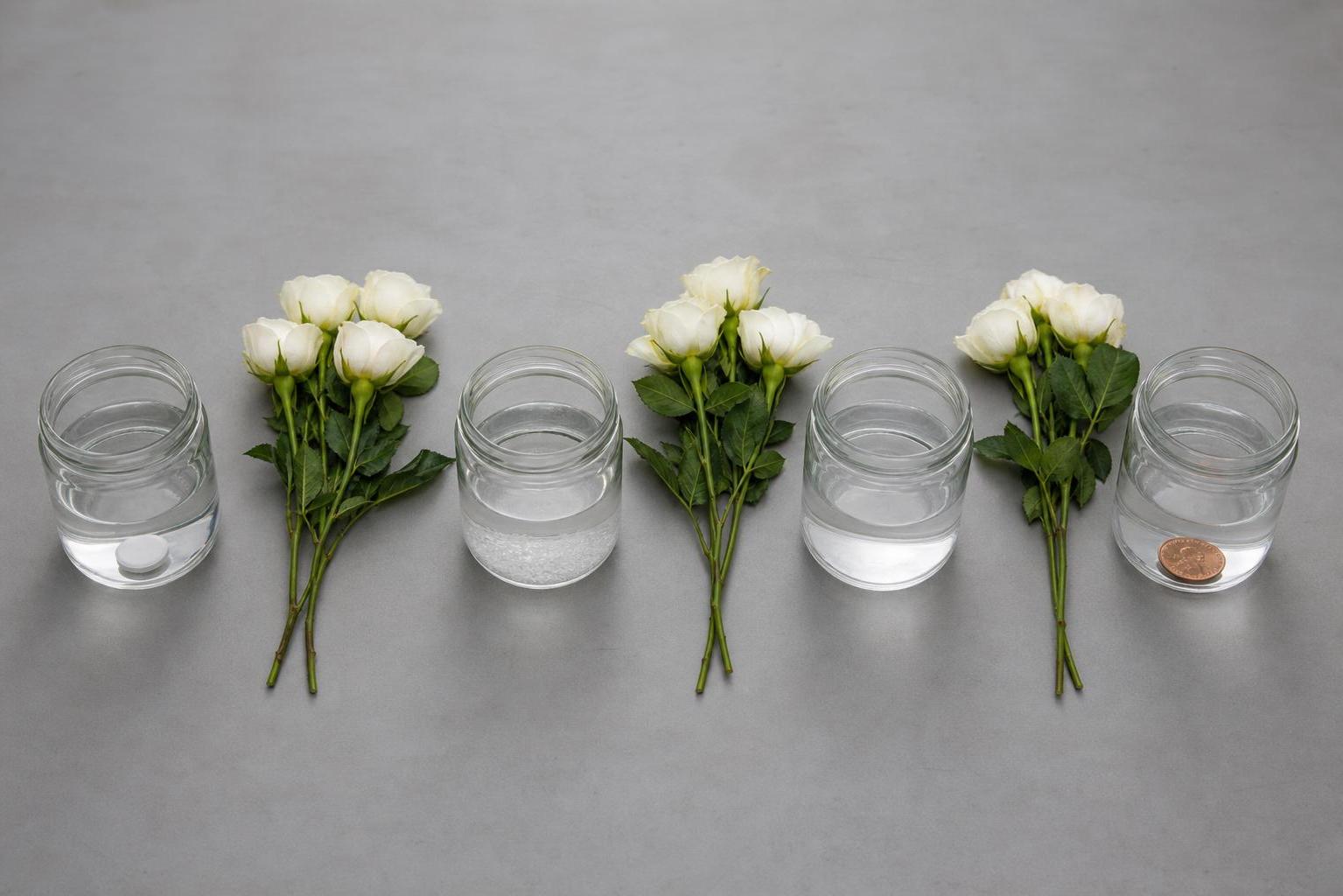
- Chrysal (or any professional flower food) — #1, no debate. Doubles the bouquet's life. Costs $1–2 per pack, enough for 10 bouquets. A serious florist should include a sachet with the purchase.
- Sugar + apple cider vinegar (1 tsp + 1 tbsp per liter) — the best "grandmother's recipe." Sugar = food, vinegar = antiseptic.
- Citric acid — a weak analog.
- Fresh water every 2 days + underwater re-cut — this works on its own, without any additive.
What doesn't work
- Aspirin — a 1970s myth
- Sugar alone — bacteria food
- Baking soda — raises pH
- Glycerin — raises viscosity
What harms
- Vodka / alcohol — burns stems
- Chlorine bleach — disaster
- Ammonia — worse than bleach
- Peroxide in large doses — damages tissue
The main takeaway
If you have flower food, use only that. If you don't, use sugar + apple cider vinegar. If you have neither, plain fresh water every 2 days + re-cut beats 80% of internet recipes.
What about the water itself?
Common question: "filtered or tap water?"
Our experience:
- Filtered or left to stand — ideal (no chlorine to hurt the stems)
- Boiled and cooled — also fine
- Straight from the tap — 10–15% worse, but not critical
- Sparkling mineral water — NO (gases harm)
- Distilled water — too "empty," flowers want minerals from ordinary water
"Correct water care" checklist
- Use flower food (or request a sachet from the florist)
- Without flower food — sugar + vinegar (1 tsp + 1 tbsp per 1 L)
- Change water every 2 days (daily in summer)
- Re-cut under water at every water change
- Filtered or standing tap water preferred
- NOT aspirin, not vodka, not bleach, not soda
If you want a bouquet with proper care
Bouquets with delivery — every bouquet comes with a flower food sachet and a care card. 8-year florist experience — no internet myths.
— Sofia Bell
Author
Sofia Bell
Florist and blog editor