Anemone is a flower with thin petals and a dark "eye" at the center — what florists call the biggest floral discovery of the last five seasons. Vase life 7–10 days, holds up to -2 °C on the shop shelf, works equally well in a mono-armful and in a rustic wedding composition. Here's three key species, garden agronomy, bouquet rules, and the symbolism that made anemone a bridal favorite in 2026.
Botanical description
Anemone (windflower) is a genus of herbaceous perennials in the buttercup family (Ranunculaceae) with about 170 species. The name comes from Greek anemos — "wind": petals open at a light draft and close before rain. Found on every continent except Antarctica, from the Alps to Japanese foothills.
Bush height ranges from 10 cm in mountain species to 120 cm in Japanese hybrids. Slender but sturdy stem, with one large flower or an inflorescence of 3–9 buds. Corolla diameter 4–9 cm; cultivar forms reach 12 cm.
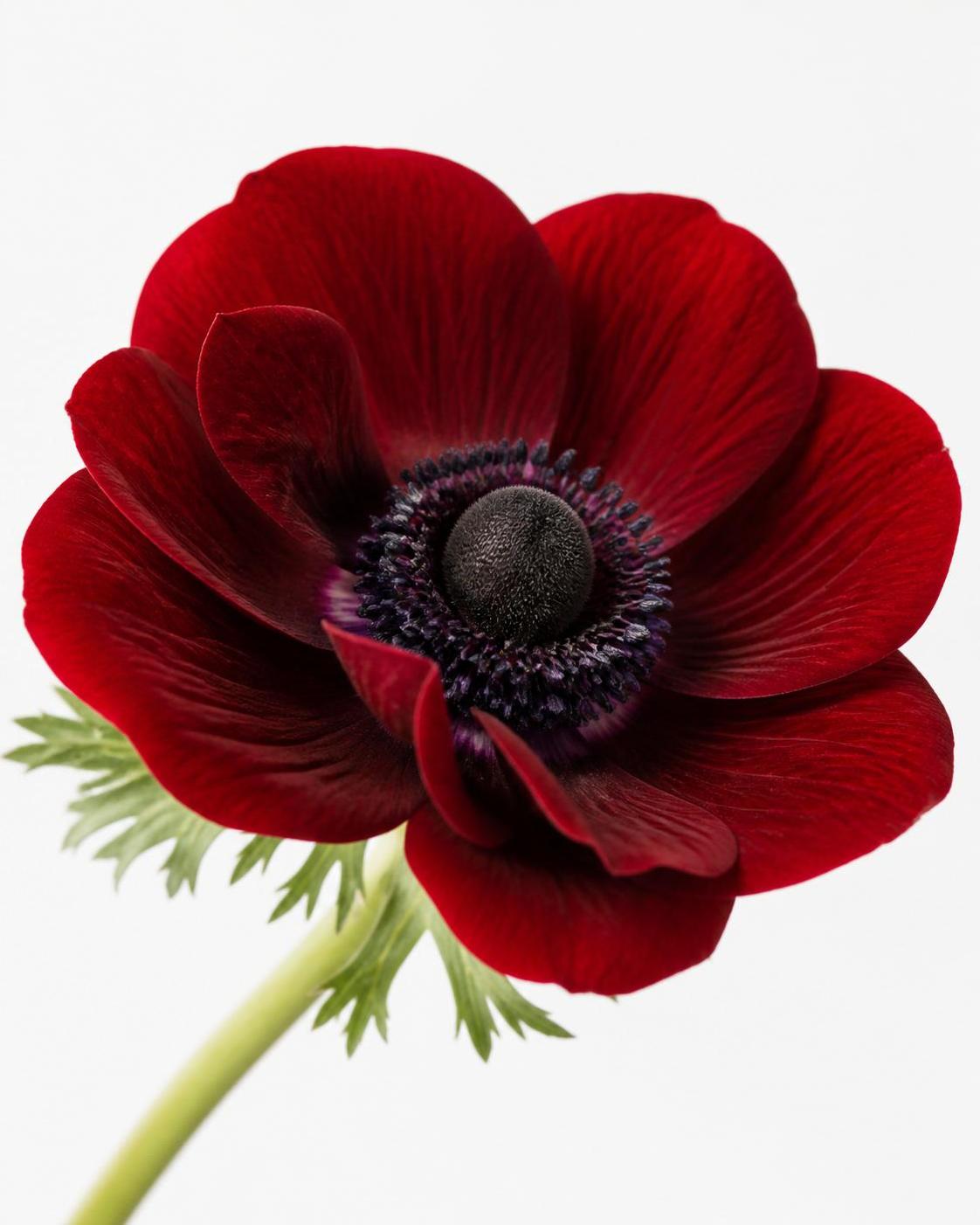
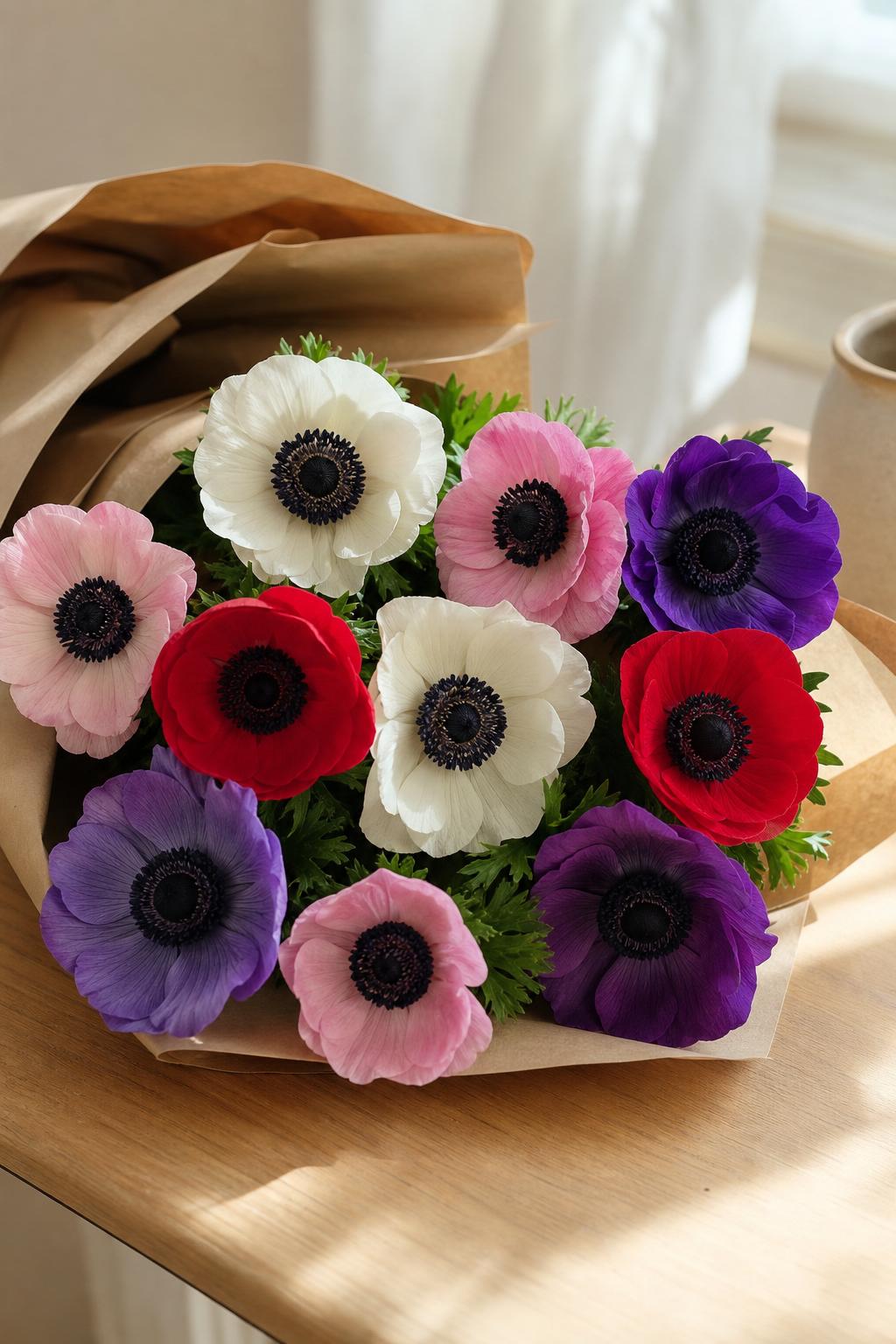
The trademark feature is the contrasting center. A dark purple or nearly black center with a crown of stamens sharply stands out against white, crimson, bright red, or pastel petals. This graphic contrast draws frequent comparisons to poppies, though botanically they're unrelated.
Species and varieties
Anemone coronaria (crown anemone)
The main florist species. Corm perennial, 30–45 cm tall, single flower 5–9 cm per stem.
Main varieties:
- De Caen — single petals, classic
- Saint Brigid — semi-doubled
- Mona Lisa — pastel palette
- Panda — white with a black center
- Meron — deep red with black center
- Marianne Pink — soft pink
Anemone × hybrida (Japanese anemone)
Autumn-blooming perennial 60–120 cm tall. Blooms August–October.
Varieties:
- Honorine Jobert — white doubled
- September Charm — pink
- Whirlwind — white with a green center
Anemone nemorosa (wood anemone)
Spring perennial 10–20 cm tall. Blooms April–May. Ideal for shaded garden beds under trees.
Varieties:
- Vestal — doubled white
- Robinsoniana — lavender-blue
- Blue Bonnet — sky blue
Planting
Coronaria (crown anemone):
- Corm soaked 3–4 hours in warm water before planting
- Plant in April (open ground) or October (winter cover)
- Depth 5 cm, spacing 10–15 cm
- Sun to light shade, drained soil
 Japanese anemone:
- Rhizome division in spring or autumn
- Depth 8–10 cm
- Semi-shade, moist rich soil
Japanese anemone:
- Rhizome division in spring or autumn
- Depth 8–10 cm
- Semi-shade, moist rich soil
Wood anemone:
- Rhizome in autumn
- Depth 5 cm
- Shade, humus-rich soil
Season care
- Watering: moderate; anemones don't tolerate dryness or waterlogging
- Feeding: at bud stage — potassium magnesium; after bloom — superphosphate
- Coronaria — lift corms after bloom in warm zones; leave with mulch in temperate
- Japanese anemone — mulch 5 cm for winter in first years
- Diseases: anthracnose, downy mildew (Bordeaux mixture prevention)
Anemone in bouquets: 6 florist rules
- Buy fresh. Anemone quickly opens fully; select flowers with a still-closed bud. Once fully open, vase life halves.
- Cool water. Anemone is thermo-sensitive; loves +12–15 °C water.
- Short stems. In a bouquet, keep anemones on 25–35 cm stems, not longer — the stem is weak and bends.
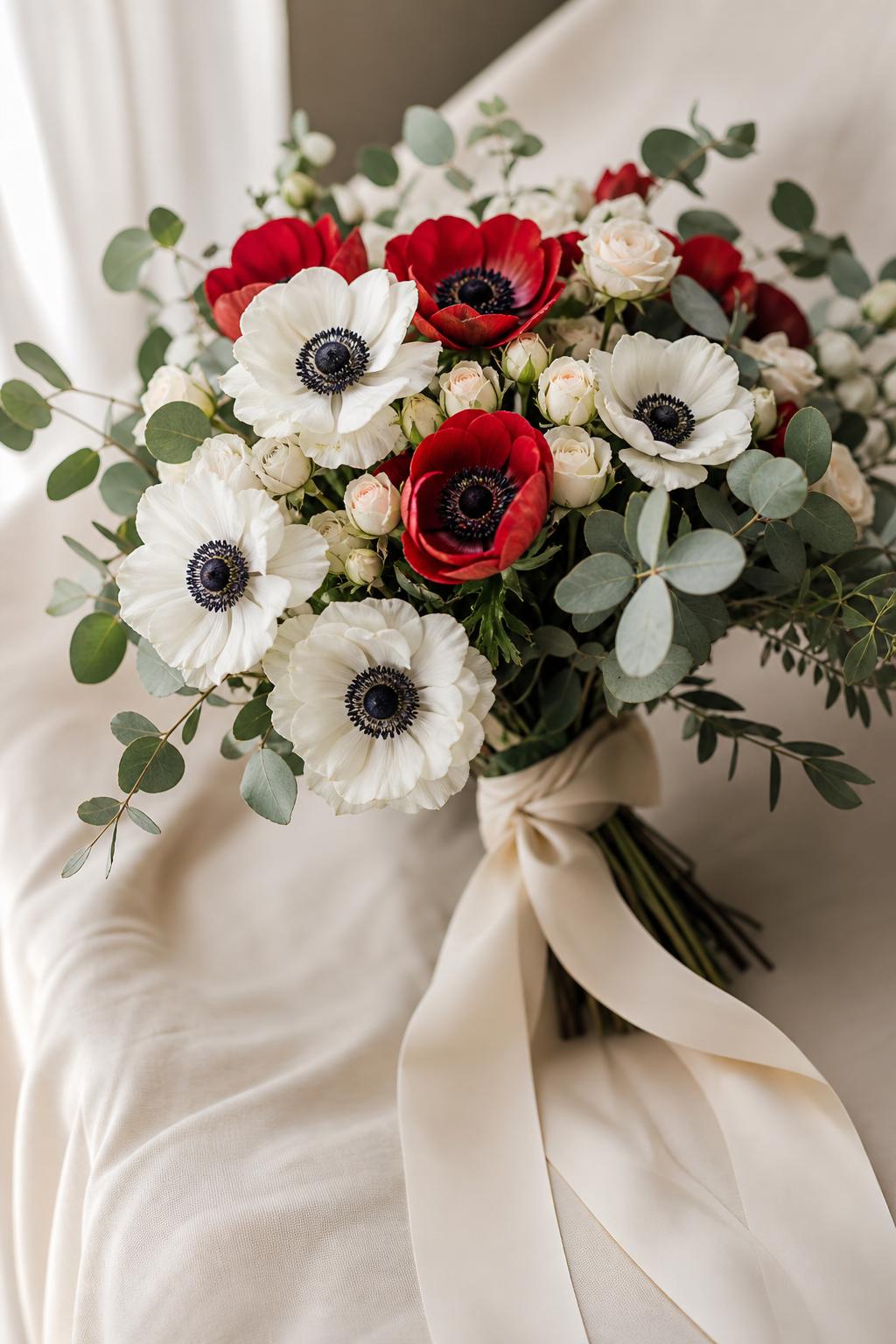
- Graphic contrast. Anemone's dark center pairs well with monochrome flowers — white, cream, dusty pink.
- Don't overwater. Vase water — max 5 cm depth; deeper leads to stem rot.
- Refresh cut daily. Anemone stems dehydrate faster than most flowers.
Working combinations
- Anemone + spray rose + eucalyptus (dusty pink wedding)
- White Panda anemone + white peony + ranunculus (elegant bride)
- Red Meron + burgundy peony + black calla (dramatic composition)
- Anemone + hyacinth + tulip (spring bouquet)
Combinations that don't work
- Anemone + gerbera (visual clash between the two "large heads")
- Anemone + sunflower (scale mismatch)
Symbolism and the language of flowers
The anemone was born from Greek mythology. Aphrodite mourned Adonis, killed by a wild boar; her tears mixed with his blood, and from that mixture the first anemone grew. Hence the flower's dual symbolism: bright life and delicate mourning.
Meaning by color:
- Red — passion, undying love
- White — pure feelings, sincerity
- Purple — anticipation, mystery
- Pink — tender affection, non-romantic warmth
- Blue — trust, dedication
In modern floristry, anemone is a symbol of intentional beauty — the flower chosen by someone with taste.
Facts and myths
- Named after Adonis. In Greek myth, anemones sprang from Adonis's blood, dropped by Aphrodite.
- The 2026 wedding trend. Anemone entered the top 5 wedding flowers in Europe and the US in 2026, driven by boho-and-vintage wedding aesthetics.
- Toxic. All anemone parts contain protoanemonin, irritating skin and toxic if ingested. Keep away from pets.
- First stopwatch. Ancient Greeks used wild anemones as a natural rain barometer — the petals close before rain.
- Fibonacci petals. Anemone petals often form Fibonacci-sequence counts (5, 8, 13) — a botanical mathematical curiosity.
FAQ
Why did my anemones fade in two days? Bought too open; water too warm; or vase too deep. Choose closed buds, cool water, low water level.
Can I grow anemone at home? Coronaria works well as a pot plant. Cool temperatures (+15 °C), sun, moderate watering.
Which variety for a bridal bouquet? Panda (white with black center) for a modern classic look. Mona Lisa mix for a pastel-palette wedding.
When are anemones in season? Coronaria — February to May and October to December (Israeli imports year-round). Japanese — August to October. Wood anemone — April to May.
Are anemones safe for pets? No, all parts are toxic to cats and dogs. Handle with gloves.
Budget? Cut anemone: $2.50–4.50 per stem. Bouquet of 11 anemones: $35–60. Wedding bouquet with anemones: $150–320.
Want a bouquet with anemones? Browse the catalogue — available year-round from imports; especially popular in bridal compositions.
Summary: anemone is the florist's "graphic contrast" tool. Dark center against a bright petal is the strongest visual signature of a bouquet. 2026 wedding standard. Key rule: cool water, low level, refresh cut daily.
— Sofia Bell
Author
Sofia Bell
Florist and blog editor