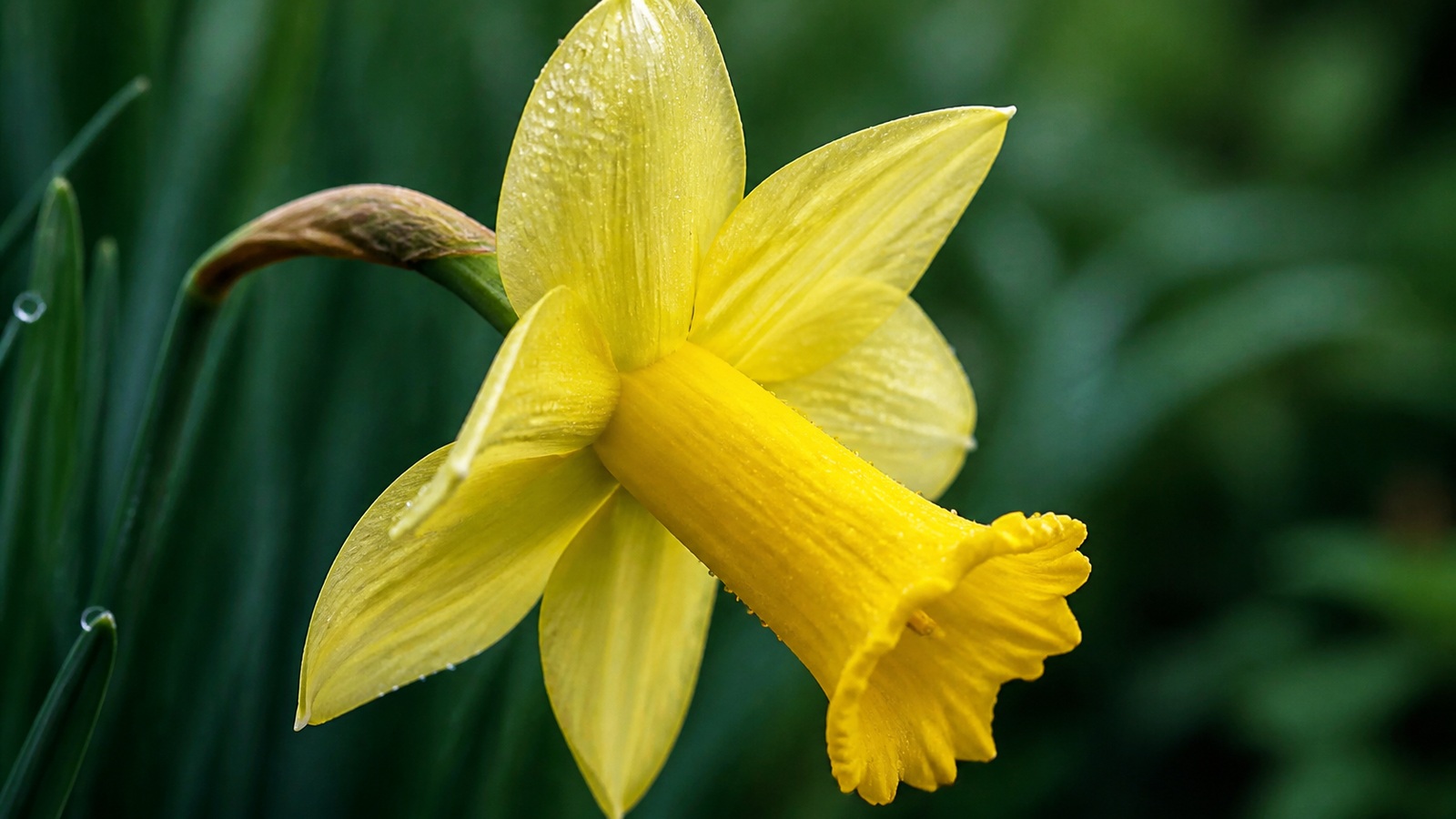
Narcissus is the second-highest-volume spring cut flower after tulip: the Netherlands alone cuts 1.8 billion stems a year. Some varieties have a short "cup" corona; others a long trumpet (like 'Tete-a-Tete' and 'Carlton'). Blooms 14–25 days in the garden, 5–7 as a cut. A special story is the toxic sap: it clogs neighboring flowers' vessels in a bouquet, so daffodils are placed separately or "conditioned" first. Here we break down 13 RHS garden classes, bouquet techniques, planting, forcing, and symbolism.
Botany and history
Narcissus is a genus in the family Amaryllidaceae — about 50 botanical species and over 32,000 registered cultivars. Native to the Mediterranean, North Africa, and the Middle East. Wild populations blanket the mountains of Spain, Portugal, and Morocco: one of the largest ranges — the Serra da Estrela mountains — turn yellow-white from late March to early May.
Daffodils entered ornamental culture earlier than tulips: the ancient Egyptians grew them 1,500 BC; the Greeks and Romans used them for wreaths and perfumery. Industrial breeding began in 18th-century England with the Backhouse family; in the 19th century the center shifted to the Netherlands.
The bulb is perennial and multi-noded: a mother bulb encloses 1–3 flower buds and 2–4 future daughter bulbs. Adult bulb diameter 4–6 cm. Leafless scape 20–55 cm tall, usually one flower per stalk; multi-flowered cultivars carry 3–8.
13 RHS classes
The Royal Horticultural Society sorts daffodils into 13 classes by flower structure.
- Trumpet — corona equal to or longer than petals (King Alfred, Dutch Master)
- Large-cupped — corona 33–100% of petal length (Carlton, Ice Follies)
- Small-cupped — corona under 33% of petal length (Barrett Browning)
- Double — doubled corona or petals (Bridal Crown, Tahiti)
- Triandrus — 2–6 flowers per stem, drooping (Thalia)
- Cyclamineus — swept-back petals (February Gold, Tete-a-Tete)
- Jonquilla — small fragrant flowers, 2–6 per stem (Baby Moon)
- Tazetta — 4–20 small flowers per stem (Paperwhite, Cragford)
- Poeticus — the "poet's daffodil" — white petals + red-edged eye (Actaea)
- Bulbocodium — hoop petticoat daffodil (Golden Bells)
- Split-corona — flat "orchid-like" corona (Cassata, Palmares)
- Miscellaneous — hybrids that don't fit above
- Species (all wild) — botanical wild types
Best varieties by group
Yellow
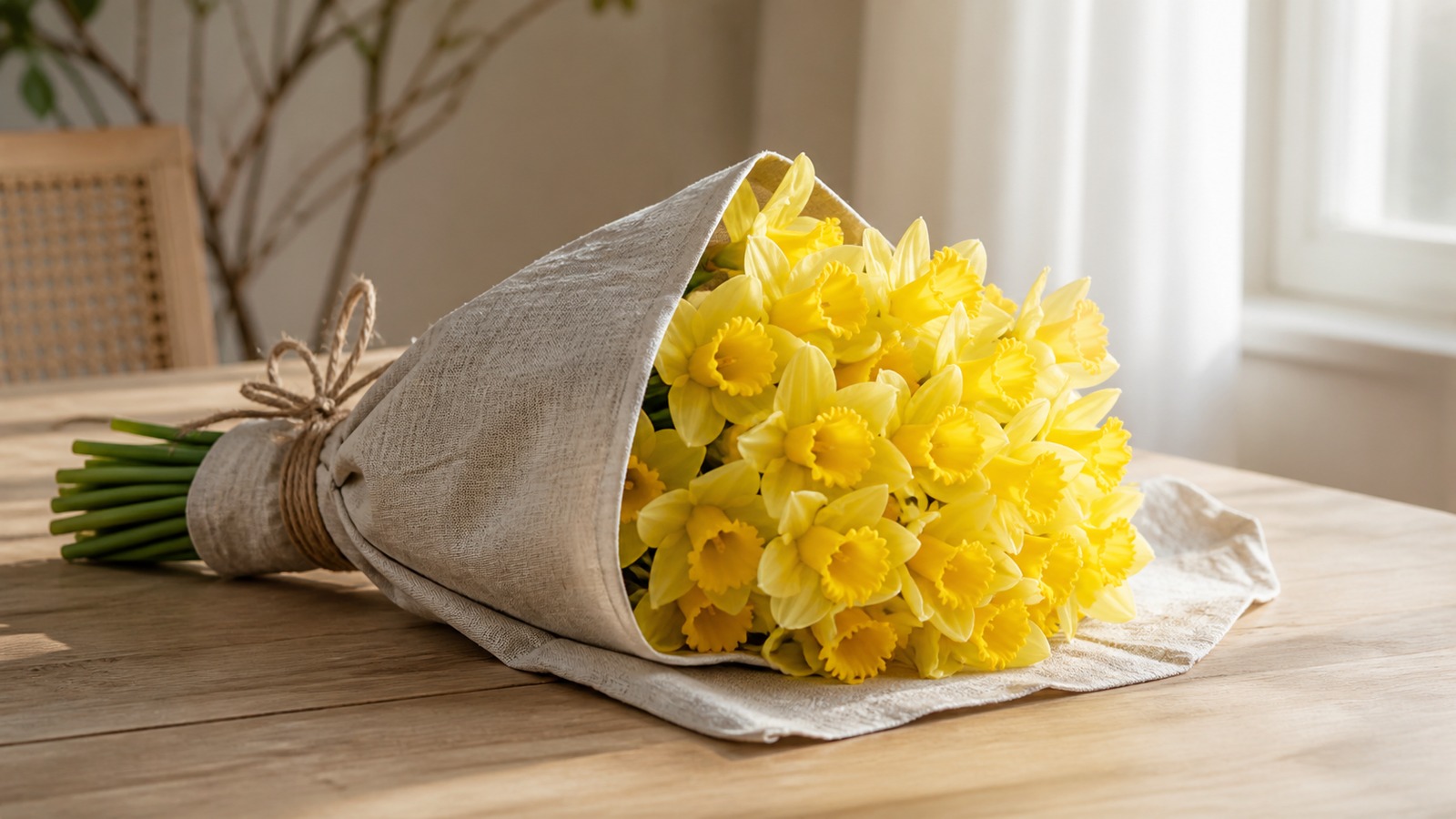
- Carlton — the market's most-sold yellow, large-cupped
- Dutch Master — classic bright yellow trumpet
- King Alfred — historic classic (1899)
- Golden Ducat — doubled bright yellow
White
- Thalia — pure white multiflowered, triandrus
- Ice Follies — white with a yellow cup fading to white
- Mount Hood — pure white trumpet
- Actaea — white with a red-orange eye (poeticus)
Pink and orange
- Salome — white with a peach-pink cup
- Pink Charm — white with a coral cup
- Fortissimo — yellow with an orange cup
- Tahiti — orange-yellow doubled
Multiflowered
- Tete-a-Tete — the world's most popular miniature, 15 cm, yellow
- Bridal Crown — creamy white doubled, fragrant, multi-flowered
- Paperwhite — snow-white, indoor forcing star, no cold treatment needed
- Cragford — cream with an orange center
Narcissus in bouquets and the sap problem
Narcissus is a spring gift classic. Mono-bouquets of 25–35 stems retail at $22–35, a fraction of a tulip bouquet's price.
The slime problem
Cut narcissus stems release a viscous slimy sap that clogs the vessels of other flowers. Tulips wilt within 4–6 hours in the same vase.
Solution — conditioning:
- Cut daffodils, place them alone in a bucket of water for 12 hours
- Rinse the cut ends under a tap without re-cutting
- Only now transfer to a shared vase with tulips or other flowers
That protocol lets daffodils coexist safely with any partners.
Working combinations (after conditioning)
- Narcissus + tulip (the spring classic)
- Narcissus + hyacinth + willow (Easter composition)
- Narcissus + iris + eucalyptus (Monet palette)
- White Thalia + spray rose + ranunculus (Easter bouquet)
Combinations that don't work
- Narcissus + peony (peony wilts fast)
- Narcissus + gerbera (aesthetic mismatch)
Cut care
- Trim at 45°, DO NOT smash the stem (releases more sap)
- Cool water, medium vase depth
- Conditioning for 12 hours before adding to shared vases
- Change water daily
- Cut ends can regenerate slime after 24 hours — refresh a shared vase early
Vase life: 5–7 days per stem, up to 10 with sequential opening on multiflower stems.
Planting and garden care
Timing: mid-September to early October, when soil at 10 cm depth cools to +10 °C.
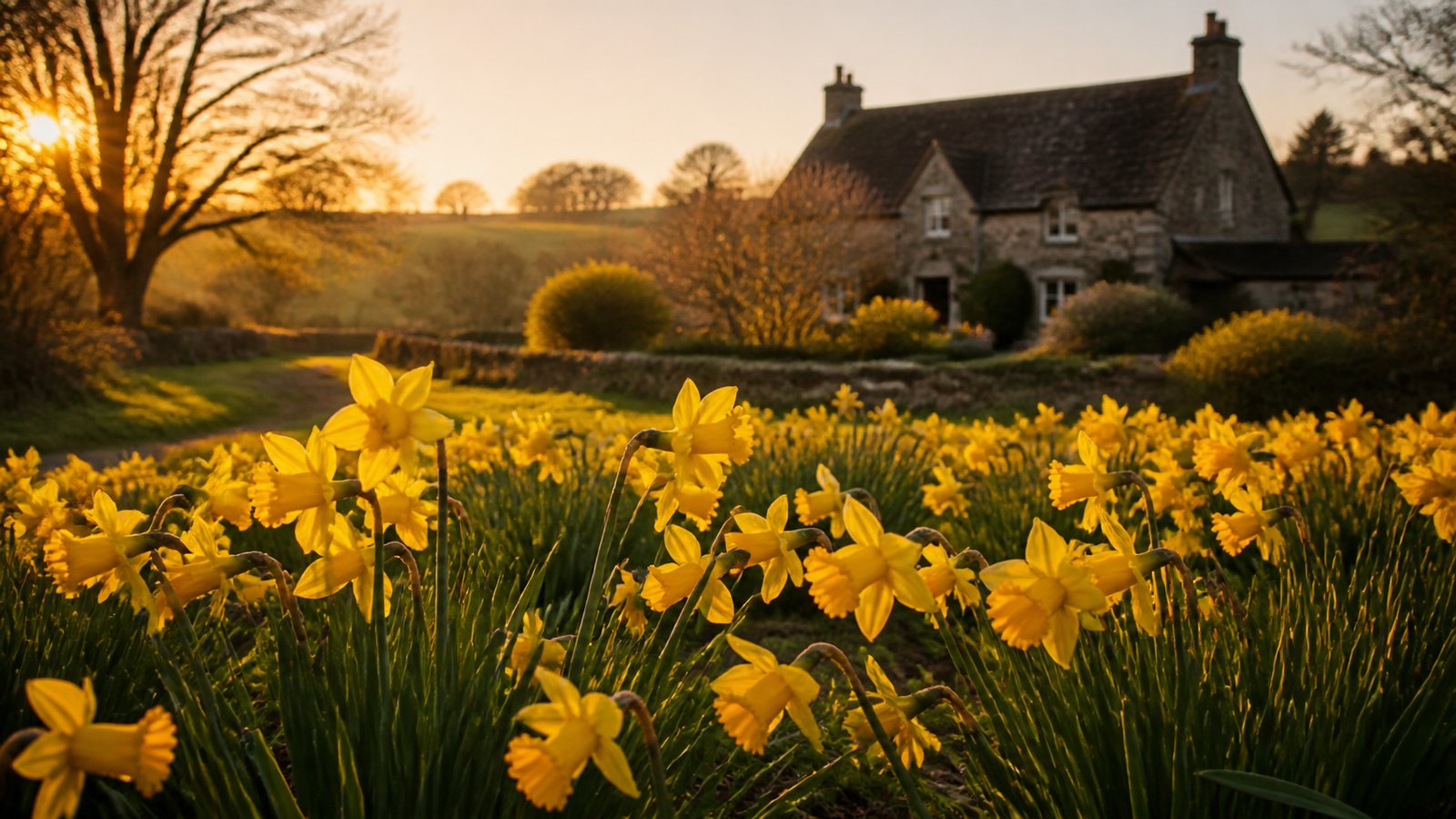
Depth: 3× bulb height. For a 5 cm bulb — 15 cm deep. Spacing: 10–15 cm.
Soil: drained, neutral pH (6.5–7.0). Sunny to lightly shaded position.
Feeding: at planting — 30 g superphosphate + 20 g potassium sulfate per m². On shoot emergence in spring — 20 g ammonium nitrate per m². After bloom — potassium magnesium 15 g/m².
Lifting: not annually. Once every 4–5 years for bulb division. Otherwise the plant thrives untouched.
Winter: cold-hardy to −30 °C without cover. Zero cover needed in temperate zones.
Forcing for March 8
Daffodils are the easiest bulb to force. Plant in a pot in November, cold-store at +5…+9 °C for 12–14 weeks, then move to warmth. Bloom 18–22 days after moving to warmth.
For March 8 (bloom):
- Plant Nov 5–10
- Cold 12 weeks (until early Feb)
- Move to warmth Feb 15
- Bloom around March 5
Paperwhite variety needs no cold treatment — plant in pebbles with water and it blooms in 4–6 weeks at room temperature. Perfect for Christmas.
Myth, symbolism, and culture
The narcissus is named after Narcissus, a beautiful youth in Greek myth. He rejected the nymph Echo, and the gods punished him: he fell in love with his own reflection in a pond and pined away, transforming into the flower that bears his name.
Symbolism:
- Yellow — sun, joy, new beginning, ambition
- White — purity, innocence, spring rebirth
- Multicolor (with orange/pink cup) — respect, chivalry
In China, narcissus is the New Year flower — a symbol of good luck for the coming year. In Wales, the daffodil is the national symbol (worn on St. David's Day, March 1). In the UK, the daffodil is the March birth-flower.
In Christian symbolism, the narcissus is a symbol of Easter and rebirth (blooms right on the Easter dates in Europe).
Facts and FAQ
- 32,000+ cultivars registered by RHS
- Toxic bulb. Narcissus bulbs are lethal to livestock and pets; contain lycorine and galantamine. Never eat or plant with edibles.
- Alzheimer's drug. Galantamine, extracted from narcissus bulbs, is an FDA-approved treatment for Alzheimer's disease
- The world's most expensive daffodil bulb was sold in the Netherlands in 2019 for €4,000 — an experimental red variety
- Britain's cancer symbol. The daffodil is Marie Curie Cancer Care's charity symbol; the yearly campaign is called "Great Daffodil Appeal"
FAQ
Can I gift daffodils with tulips? Yes, but after conditioning daffodils separately for 12 hours. Otherwise they poison the tulips.
Are daffodils toxic to cats? Yes, all parts, especially the bulb. Keep out of reach.
When do daffodils bloom in the garden? Cyclamineus and dwarf types — March. Large-cupped — April. Poeticus — May.
Why don't my garden daffodils bloom? Overcrowded bulb cluster (need dividing) or planted too deep.
Budget? Cut daffodil bouquet: $15–35. Potted forced narcissus: $12–20. Paperwhite kit: $18–25.
Can I plant supermarket bulbs? Cut-flower bulbs are usually spent after forcing but can be planted outdoors; may take 1–2 seasons to bloom again.
Want a spring bouquet with daffodils? Browse the catalogue — available February through April, mono-bouquets from $22.
Summary: narcissus is a spring florist's classic. Bright palette, huge cultivar range, easy to force. Key rule: condition separately for 12 hours before adding to shared bouquets — the sap kills other flowers. Handle with care — toxic to pets and the plant contains active pharmaceutical compounds.
— Sofia Bell
Author
Sofia Bell
Florist and blog editor